tippinsights Editorial Board, TIPP Insights
Terrorists Awaken a Sleeping Giant, Ignite Chaos, Flirt With Nuclear Fire.
Tragedy struck on Tuesday in the picturesque meadows of Pahalgam, a mountain town near Srinagar, the capital of Jammu and Kashmir, India. As Indian tourists, primarily from the southern states, sought relief from the intense heat and enjoyed their summer vacations in what is often called ‘God’s country,’ were attacked by militants.
In a chilling echo of Gaza-style tactics, social media reports said that militants separated the men from their wives and children. In Nazi style, the men were asked to strip to show their genitals in a clear sign that the terrorists wanted to harm Hindu men.
Hindu religious rituals do not include circumcision or any mandatory genital operations as part of their faith, unlike many Christian, Muslim, and Jewish traditions where circumcision is a religious rite. Hinduism has no scriptural or doctrinal requirement for such practices.
The terrorists asked each victim to recite the “Kalima,” a fundamental expression of belief in the oneness of Allah and the prophethood of Muhammad. While the term itself is not explicitly mentioned in the Quran as a specific concept, it is derived from Islamic tradition. It refers to key phrases that encapsulate core Islamic beliefs. The most important and commonly referred to recitation is the Kalima Tayyiba (the Pure Word): “La ilaha illallah, Muhammadur Rasulullah.” Translated, it means, “There is no god but Allah, and Muhammad is the Messenger of Allah.”
The declaration is considered the first pillar of Islam (Shahada) and the entry point to the faith. None of the 27 Hindu men knew the lines. All of them were executed in cold blood in front of their families.
Indians are avid users of social media, and soon after the killings, reports began pouring out of the Himalayan hillside. One link showed a young widow grieving beside her slain husband — they were on their honeymoon. Another post showed a middle-aged couple enjoying a Gondola ride on Dal Lake in Srinagar before they made the trip up to Pahalgam. The man was mercilessly shot. The wife asked the terrorists to kill her, too. But the militants refused, asking her to talk to Indian Prime Minister Narendra Modi.
Modi was on an official visit to Saudi Arabia. Upon learning of the attack, he cut short his visit and rushed to New Delhi. A senior coterie of Indian officials was already in Srinagar planning the next moves. By the time this piece is published on Wednesday morning, we fear rising public anger may pressure the Indian government toward a military response—not because it is the wisest course, but to placate the anguish of nearly a billion Hindus
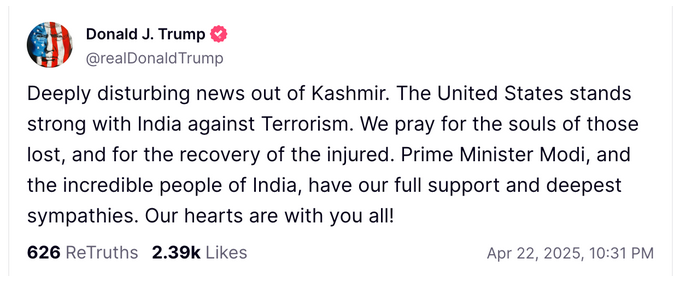
In both the Ukraine-Russia and Israel-Hamas wars, one of the powers has nuclear weapons, the other doesn’t. However, a conflict in the Kashmir Valley will bring two archrivals, India and Pakistan, both nuclear-armed nations, into war. The world cannot afford this conflict at all. In another replay of Gaza 2.0, President Trump immediately announced solidarity with Modi. We carried Trump’s remarks in our new Breaking News coverage on the TIPP website.
The roots of the Kashmir Valley struggles go back to the period when India and Pakistan were partitioned in 1947. A Hindu king then ruled Kashmir, a land rich in natural beauty, water and glacial resources, pine trees, and orchards. The province had been home to a mix of ethnic groups – Muslims in the Kashmir Valley, Hindus in Jammu, and Buddhists in Ladakh. At the time of partition, Kashmir was divided into two regions, controlled by India and Pakistan, respectively.
In 1950, when India adopted its Constitution, a special temporary provision was incorporated (Article 370), giving Jammu and Kashmir autonomy in internal affairs, while Article 35A protected local land and job rights. In effect, citizens from the rest of India could not own property in Jammu and Kashmir. [After Sino-Indian War in 1962 and following agreements with Pakistan, Kashmir was divided into three regions – Indian-occupied (45.6%), Pakistan-occupied (35.2%), and China-occupied (19.2%).]
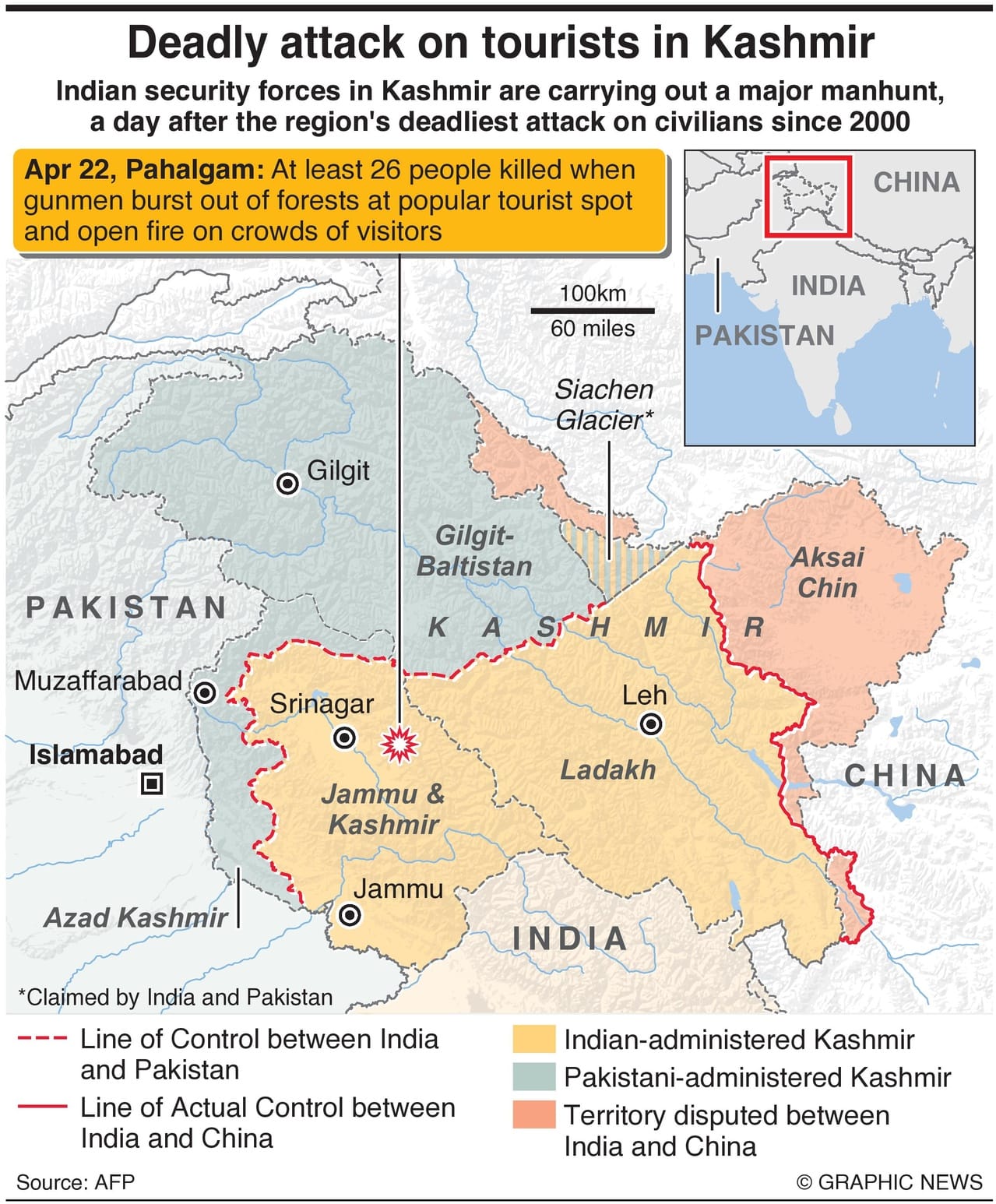
Kashmir has been a flashpoint between India and Pakistan since the two countries formed. Just as when Israel was formed from what was previously Palestine and when the Arab states attacked Israel after its founding in 1948, Pakistan-backed tribal militias invaded Jammu and Kashmir, prompting the Maharaja to ask India for military support, which India readily provided. The United Nations brokered an uncomfortable ceasefire in January 1949.
The two sides fought again in 1965 when Pakistan resorted to insurgency––tactics perfected by the PLO, which, led by Yasser Arafat, had launched its first armed operation on Israel’s National Water Carrier, an infrastructure project, the same year. India responded with all of its might to crush the insurgency. The war ended in a stalemate with the Tashkent Agreement in January 1966, restoring pre-war boundaries along the Line of Control, with no significant territorial changes.
Six years later, in 1971, India fought Pakistan when the latter’s crackdown in then-East Pakistan (now Bangladesh) triggered a refugee crisis as millions sought shelter in India. Seeing that India was fighting in the East, Pakistan launched a western front to attack India in Kashmir. India decisively won the war, creating a new country, Bangladesh.
In 1999, Pakistan-backed militants and regular troops infiltrated Indian-administered territory in Kargil across the LoC. Again, India won when it regained complete control of the sector.
During the peak of the Kargil militancy, daily skirmishes between Indian troops and Pakistan fighters, supported by its intelligence arm, the ISI, became commonplace. The impoverished citizens of the state lagged in development as tourism, the main driver of its economy, suffered.
Prime Minister Modi has been in power since 2014. Sensing that the Jammu and Kashmir situation must be resolved and the state must be re-integrated into India’s growing economy, he pushed Parliament in 2017 to retire the special provisions, Articles 370 and 35A. In 2023, a five-judge constitution bench of the Indian Supreme Court unanimously upheld the 2019 abrogation, ruling that Article 370 was a “temporary provision” and its revocation was a valid exercise of parliamentary power.
Since 2017, an uneasy calm had returned to the state. Tourism slowly began to rise as Indian paramilitary forces watched crucial intersections. The locals, many of them Muslim, benefited economically but privately detested the presence of the police.
Yesterday, militants struck to drive a further wedge between the locals and the Indian government, hoping to choke all tourism off and unleash a period of terror and a return of uncertainty. As we said, Gaza 2.0 tactics are now playing out, 2,200 miles to the east.