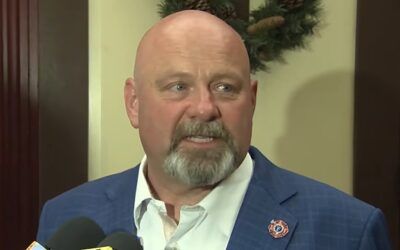
California’s already chaotic governor’s race just took another sharp turn.
Rep. Eric Swalwell, the progressive firebrand who has spent years attacking conservatives and President Donald Trump, is now under fire himself after a new lawsuit claims he may not even qualify to run for California’s top office. The bombshell filing alleges Swalwell doesn’t actually live in California at all.
The five-page petition for writ of mandate, filed in Sacramento by conservative activist and filmmaker Joel Gilbert, targets both Swalwell and Democratic Secretary of State Shirley Weber. At the center of the dispute is a basic legal requirement: under California’s Constitution, a governor must have lived in the state for the previous five years.
“The governor shall be an elector who has been a citizen of the United States and a resident of this state for 5 years immediately preceding the governor’s election,” the filing states, citing Article V, section II.
According to Gilbert, Swalwell’s own paperwork may be his undoing.
The lawsuit claims that Swalwell has repeatedly listed his Washington, D.C. residence — not a California home — as his primary address. Even more damaging, the complaint alleges that the address Swalwell used on a key campaign document isn’t a residence at all, but his attorney’s office.
“Public records searches reveal no current ownership or leasehold interest held by Eric Swalwell in California, nor any history of any ownership or leasehold interest based on available public records,” the lawsuit reads. “Swalwell’s congressional financial disclosures from 2011 to 2024 list no California real estate ownership.”
The filing goes further, warning that the absence of any legitimate California residence could permanently bar Swalwell from the ballot.
“Swalwell’s declared principal residence in Washington, D.C., coupled with his absence of any California residence, defeats California domicile. Once ballot preparation or certification deadlines pass, no post-hoc judicial remedy can restore a lawful ballot.”
The issue isn’t merely technical — it could carry serious legal consequences.
“Either he’s guilty of mortgage fraud in Washington, DC, or he’s ineligible to run for Governor or California, he can’t have it both ways.”
Gilbert’s legal challenge also accuses Swalwell of perjury, noting that the congressman signed official filings under penalty of perjury while allegedly listing a non-residential address as his home.
“Eric Swalwell used his attorney’s address as his HOME address on the Candidate Intention Statement.
He signed under penalty of PERJURY.
Not only should he be forced to withdraw, but he should face charges.”
Gilbert argues that allowing an ineligible candidate to remain on the ballot would damage public trust and election integrity — something Democrats frequently claim to defend.
His lawsuit urges Weber to “fulfill her constitutional duty” and disqualify Swalwell before irreversible harm is done to California voters and the election process.
Swalwell, 45, was born in Iowa but raised in California and has represented the Bay Area in Congress since 2012. Like many members of Congress, he spends much of his time in Washington, D.C. However, unlike House candidates — who only need to reside in the state they represent — gubernatorial candidates must meet strict residency requirements.
“Congressional candidates don’t have to live in the specific district they represent, but they do have to live in the same state,” Gilbert noted.
The congressman responded briefly on social media, brushing off the lawsuit with a dismissive tone.
“See you in court, Joel!”
The controversy didn’t start in court. Gilbert says he attempted to confront Swalwell earlier this month at a town hall event at Santa Monica High School — and was promptly removed.
The Democrat “had an opportunity to respond to Gilbert’s allegations when the filmmaker attended his town hall earlier this month at Santa Monica High School,” according to the Daily Mail. “Instead, Gilbert claims ‘three goons’ surrounded him and kicked him out before he had a chance to speak.”
“He only took eight questions, then cut it off. I was in the photo line when they approached me and asked me what my plan was,” Gilbert recounted.
“I said I wanted to take a picture with the congressman. They said they weren’t going to allow that and told me I had to leave,” he added. “I believe Swalwell recognized me, and he was afraid of answering questions.”
Swalwell announced his gubernatorial ambitions during a friendly appearance on “Jimmy Kimmel Live!” in November — a fitting venue for a campaign critics now say is more performance than substance.
With California facing crime, homelessness, high taxes, and mass exodus, conservatives argue voters deserve transparency and accountability — starting with whether a candidate actually lives in the state he wants to govern.
As the legal clock ticks, the question remains: will California Democrats enforce their own Constitution, or look the other way when one of their own is caught cutting corners?