

Sarah Palin just lobbed a rhetorical grenade straight at Chrissy Teigen—and frankly, it’s about time someone did. In the aftermath of the shocking violence tied to the White House Correspondents’ Dinner, Palin dragged one of Teigen’s nastiest old tweets back into the spotlight.
And it’s a doozy.
“Listen, I don’t want much from Sarah Palin,” Teigen once wrote. “I just want her to admit partial fault, then shoot herself in the face. Is that wrong?”
Yes, Chrissy. It is.
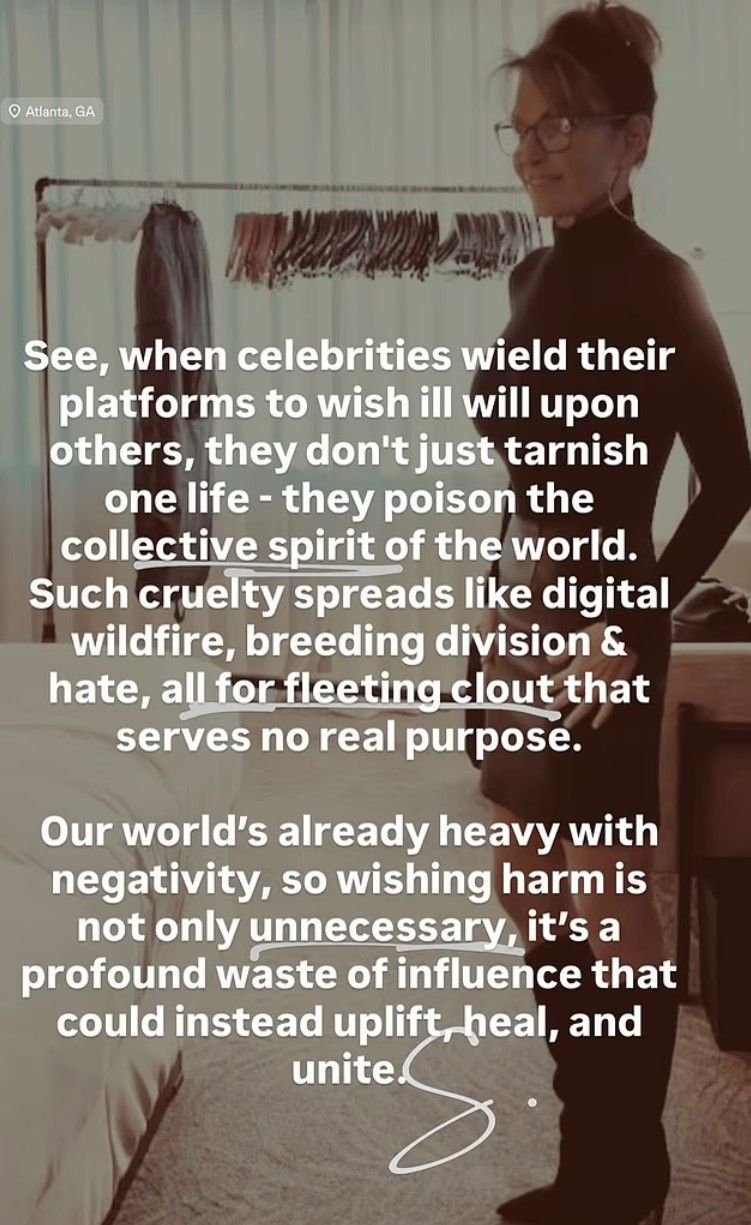
Palin, clearly unimpressed with Hollywood’s selective amnesia, reposted the remark and fired back with a blunt question: “who hurt you.” But she didn’t stop there. In a broader swipe at celebrity culture, Palin warned that this kind of bile isn’t just edgy—it’s corrosive.
She wrote that she’s “all for” free speech, but added: “when celebrities wield their platforms to wish ill upon others, they don’t just tarnish one life – they poison the collective spirit of the world. Such cruelty spreads like digital wildfire, breeding division and hate, all for fleeting clout that serves no real purpose.”
To be fair, Teigen has spent years trying to clean up her online record, admitting she was “ashamed” of her past posts and calling herself an “insecure, attention-seeking troll.” But resurfaced receipts have a funny way of sticking around—especially when the national mood turns serious. And serious it is.
The backlash isn’t happening in a vacuum. Conservatives have been hammering what they see as a pattern: overheated, dehumanizing rhetoric from the left that suddenly looks a lot less harmless after real-world violence.
Take Jimmy Kimmel, who also found himself in hot water after joking that First Lady Melania Trump might become an “expectant widow” ahead of the same DC event. Ha ha?
Not according to Donald Trump, who called the remark “far beyond the pale” and demanded ABC and parent company The Walt Disney Company show him the door.
Melania didn’t mince words either, blasting Kimmel’s “hateful and violent rhetoric” as something that “deepens the political sickness within America.” She went further, calling him “a coward” propped up by a network unwilling to hold him accountable.
And then there’s Katie Porter, a Democratic gubernatorial hopeful who thought it was a great idea to blast out a donor email repeating “F**k Trump” four times—one day after the attack.
Party officials slammed the message as reckless and inflammatory, arguing it’s proof some candidates are more interested in stoking rage than leading responsibly.
Meanwhile, investigators say the suspected gunman, 31-year-old Cole Tomas Allen, may have been fueled by—you guessed it—political grievance. His reported manifesto railed against Trump-era policies and painted violent action as a moral response to perceived injustice. That’s the through line nobody wants to admit: rhetoric doesn’t exist in a vacuum. It seeps, spreads, and sometimes explodes.
No, a bad joke or a vile tweet doesn’t pull a trigger. But when the cultural elites normalize talk of harm—when “shoot herself in the face” passes as edgy humor—it sets a tone. And that tone, as Palin put it, can “poison the collective spirit.”
The irony? The same crowd that lectures endlessly about “dangerous language” suddenly clams up when it’s their own words under scrutiny.
Palin’s message cuts through the noise: influence is a privilege. Use it to “uplift, heal and unite”—or don’t be shocked when the backlash hits. Because in today’s America, the receipts always come due.










grey box