

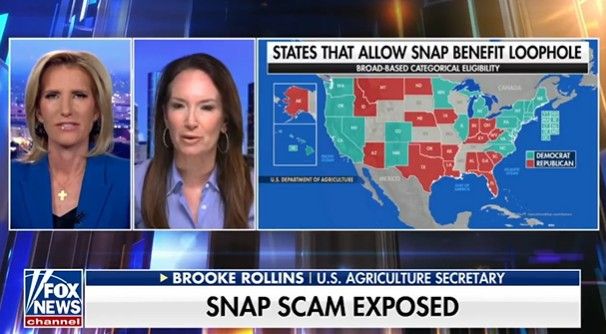
In a revelation that’s already lighting up partisan fault lines, Agriculture Secretary Brooke Rollins says a deep dive into food stamp data has uncovered what critics have long warned about: widespread abuse hiding in plain sight.
And that’s only from states willing to cooperate.
According to Rollins, officials sifted through a mountain of data tied to the Supplemental Nutrition Assistance Program (SNAP), better known as food stamps. What they found is enough to make taxpayers do a double take.
“Fraud and abuse in the SNAP program, the food stamp program, will end. And please be our partner in this. Twenty-nine states responded,” she said.
But don’t expect a kumbaya moment. Rollins made it clear who’s playing ball—and who isn’t. “All but two were of course red states, Republican governors, and they said yes we are in.”
And once the data started flowing? The numbers got ugly—fast. “And within that data dump, billions of pieces of data that we’re now sharing with the states, we found 500,000 people getting more than one benefit illegally. We found 244,000 dead people!”
Hundreds of thousands allegedly double-dipping—and nearly a quarter-million recipients who, according to the data, shouldn’t even be breathing, let alone collecting benefits. And this isn’t just a paperwork problem. It’s turning into a law enforcement issue.
“This is just the red states. In that time, we have now arrested, it’s just the red states, we have now arrested 895 different people in the last year for illegally using the food stamp system.” Rollins says the effort is just getting started, with officials now tracking where the money actually went. “And now, of course, we’re talking about what is happening with that money. So we’re making a lot of progress.”
But the bureaucratic cleanup always leads to full-blown political drama. “Of course, the blue states are SUING us to say that they don’t have to share that data. But the corruption is absolutely astounding.” Resistance from some states raises serious questions about transparency and accountability. Opponents, meanwhile, say data-sharing fights often hinge on privacy concerns and federal overreach.
But, if this is what turned up in just the cooperating states, you can bet the next question practically asks itself—what’s hiding in the rest of the country?









The blue states won’t comply, because they’re getting most of this fraud money. They are the cream of the scum.
I would inform any noncompliant state that their decision is not voluntary. All SNAP payments will cease until records are received.