

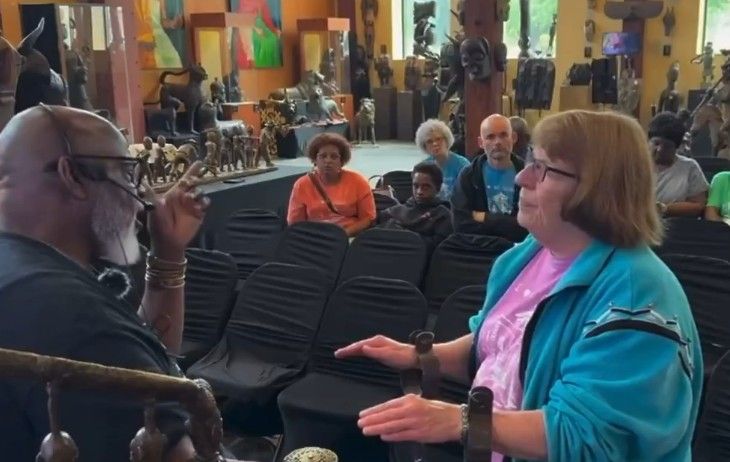
There’s no shortage of ways Americans process the legacy of slavery — from serious academic study to heated political arguments about reparations and national memory. And then there are museum exhibits that take a far more theatrical route.
At the Roots 101 African American History Museum in Louisville, one particular display has sparked attention for its unusually hands-on approach to historical interpretation. According to reporting and commentary circulating online, the museum’s founder has at times used replica iron shackles during guided experiences, placing them on willing visitors while framing the moment as a way to confront the emotional reality of the transatlantic slave trade.
The pitch is straightforward: step into a simulation, hear the words “welcome to America,” and reflect on what that might have felt like in the darkest chapters of American history. Supporters describe it as immersive education designed to generate empathy rather than abstraction. Critics, meanwhile, see something closer to performative shock therapy — a curated moment of discomfort presented as enlightenment.
What’s added fuel to the debate is the funding. The museum is slated to receive public support reportedly totaling around $1 million in city budget allocations, money intended to help preserve and present African American history from slavery through the present day. That figure alone has raised eyebrows among skeptics who question whether taxpayer dollars should be underwriting experiential exhibits that blur the line between education and performance.
Predictably, reactions have fallen along familiar cultural lines. Some see the exhibit as a necessary, if uncomfortable, confrontation with historical reality — a way of making abstract history feel immediate. Others dismiss it as symbolic theater that risks reducing a complex and brutal history into a staged moment designed for maximum emotional reaction and social media attention.
And so the larger question lingers: when does immersive education become spectacle? And when does spectacle stop being education?
No, this is not AI or satire
This is an exhibit in a museum that just got a $1 million grant from Louisville pic.twitter.com/munQztFW0z
— End Wokeness (@EndWokeness) May 13, 2026












I’m looking forward to the John Casor/Anthony Johnson exhibit.