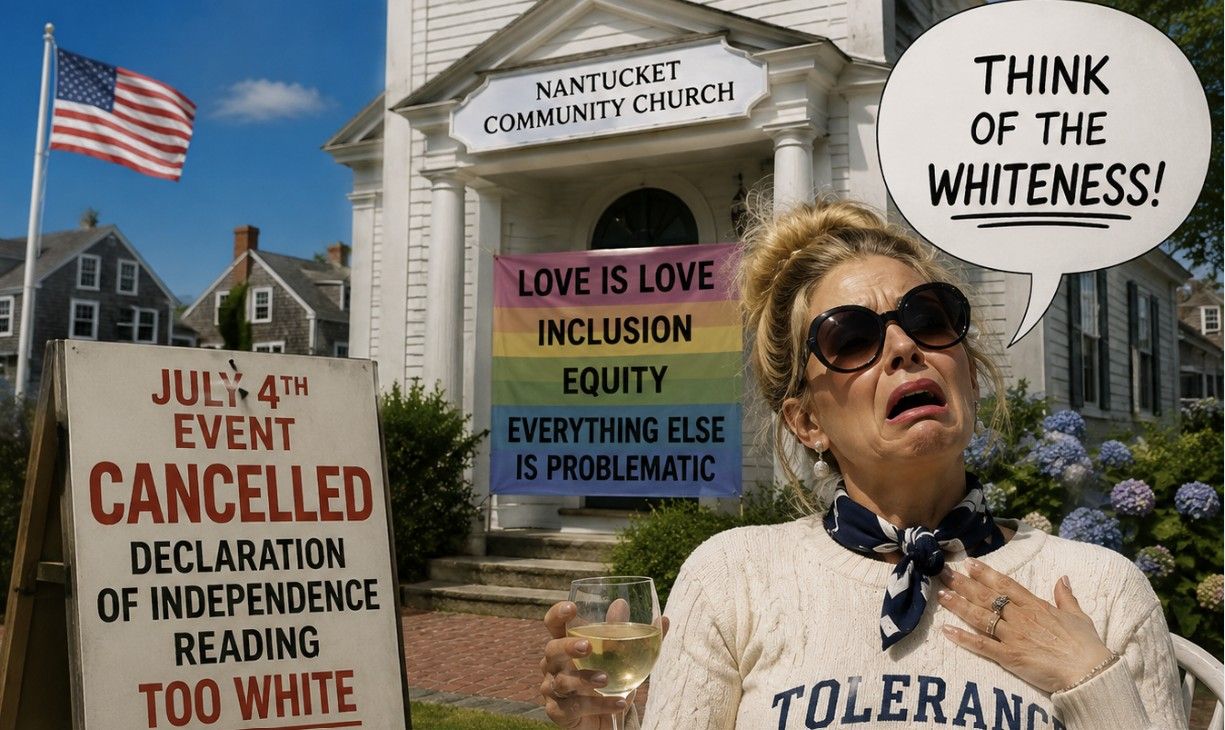
On an island famous for hedge-fund fortunes, beachfront mansions and celebrity sightings, a church has apparently found a new villain to battle: the Declaration of Independence.
In a move that perfectly captures the mood of America’s luxury liberal enclaves, Nantucket’s Unitarian congregation has pulled the plug on a beloved Fourth of July tradition that had stood for a quarter century. For 25 years, island residents gathered to hear public readings of the Declaration of Independence and the Bill of Rights. This summer? Not so much.
The reason offered by church leaders has left many Americans scratching their heads.
In a public letter, church officials explained that canceling the event was part of an ongoing effort to better understand “our own whiteness.” The letter argued that the rights and liberties outlined in America’s founding documents were historically applied unequally and often denied to nonwhite Americans.
That observation is hardly controversial history. The controversy is what came next: deciding that the proper response is to shelve a community Independence Day tradition altogether.
America is in the midst of preparations for its 250th birthday celebrations, with communities across the country organizing events that commemorate the nation’s founding and the remarkable experiment in self-government launched in 1776. Yet on one of the nation’s wealthiest islands, church leaders concluded that a public reading of the very documents that inspired democratic movements around the world had become problematic.
And this isn’t just any island. Nantucket has long served as a playground for the affluent and politically connected. Former President Joe Biden and his family spent decades making annual Thanksgiving pilgrimages to the island. Movie stars, Wall Street executives, billionaires and power brokers regularly flock there for summer retreats far removed from the struggles of everyday Americans. Which is why critics saw more than a little irony in affluent residents lecturing the rest of the country about privilege.
Social media users wasted no time expressing disbelief. “If you know anything about Nantucket, you know that’s where the rich, privileged people live. Just another self important dem who thinks she’s important,” one commenter wrote, urging residents not to let “this idiot spoil your fun.” Another user quipped, “Nothing says ‘inclusive’ like canceling a national holiday.”
Others pointed to the broader historical context often omitted from modern activist narratives. “Someone needs to tell this nitwit that over 600,000 white men died in the battle to end slavery in this country — by the way, the only country that decisively fought to end slavery,” one critic wrote. “I’m so tired of these people spewing lies because they refused to learn the truth. Pick up an old history book. It’s there.”
The church’s letter also announced that its leadership would not engage critics on social media, suggesting those with concerns schedule appointments instead. According to the statement, “Social media is not the place for important, tender conversations.” That response did little to cool the backlash.
The irony, of course, is that nearly every major civil-rights victory in American history relied on the principles embedded in those founding texts. Abolitionists cited them. Suffragists cited them. Civil-rights leaders cited them. The promise of equal rights under the law was not the obstacle to progress; it was the standard against which America’s failures were measured.
Fortunately for island residents who still wanted to celebrate Independence Day, the tradition won’t disappear entirely.
Another congregation, St. Paul’s Episcopal Church, stepped in to keep the reading alive. Rev. Max Wolf defended the decision, saying, “We may not be there yet but we felt it was important to gather together and try to live up to the promises our country has made. Those documents are aspirational.”
America’s founding documents were never a claim that the nation had achieved perfection. They were a declaration of principles and aspirations — a roadmap toward a freer society. Generations of Americans fought, sacrificed and struggled to make those promises real for more people. Canceling a reading of the Declaration doesn’t advance that mission. It simply turns America’s birthday into another exercise in elite self-flagellation.
As the nation approaches its 250th anniversary, most Americans seem more interested in improving the country than apologizing for its existence. And judging by the reaction in Nantucket, many are growing tired of institutions that mistake national gratitude for national guilt.
Wtf. Erin Splaine, the “Reverend” of the woke Unitarian Universalist Church in Nantucket, just canceled July 4th celebrations because White people are “privileged” and honoring American history “perpetuates the harm, injustice, and anti-democratic process.”
She then forbids… pic.twitter.com/uv9SDih7gn
— Libs of TikTok (@libsoftiktok) May 29, 2026