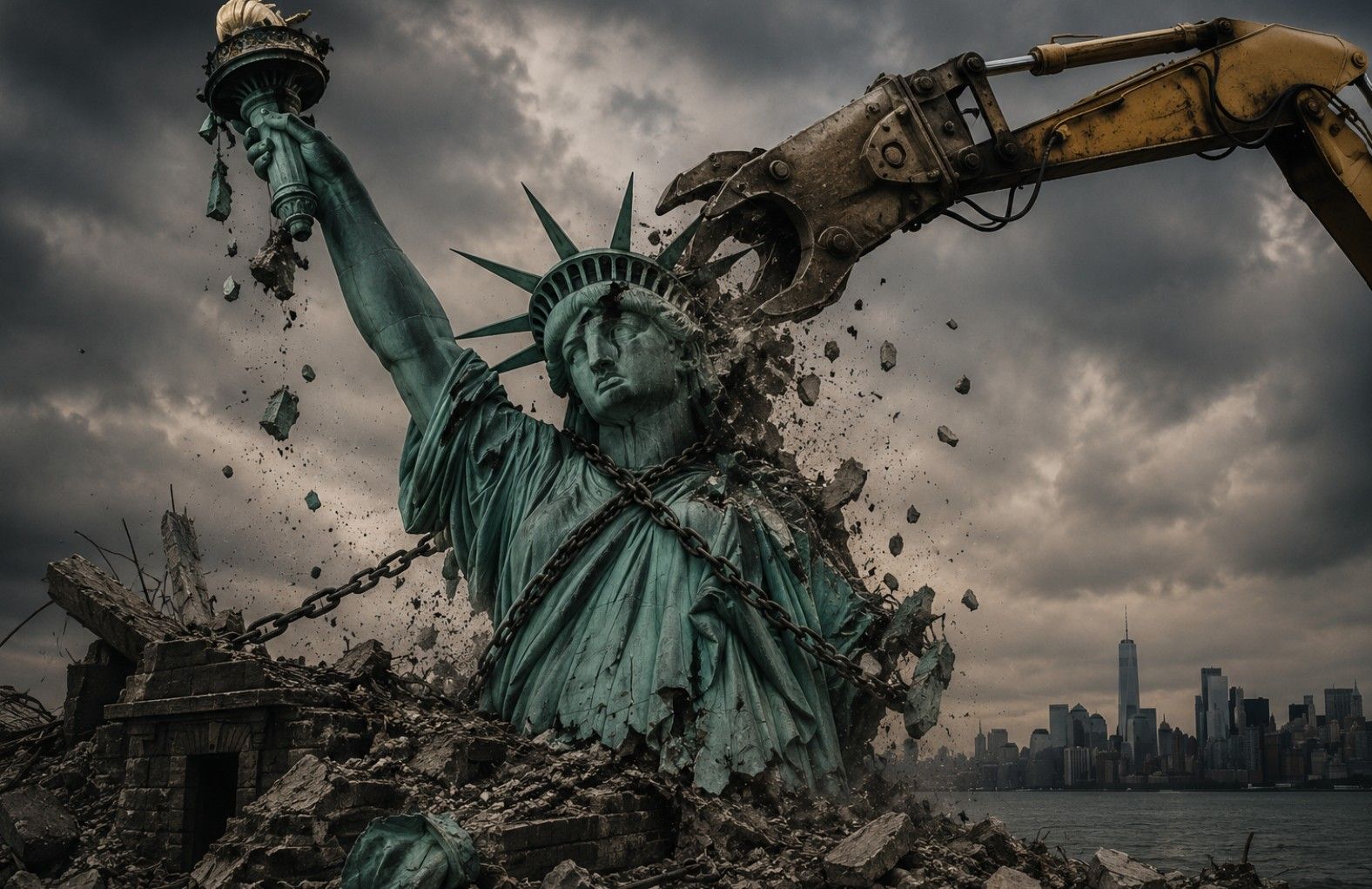
A federal courtroom showdown over President Donald Trump’s White House renovation plans took a dramatic turn Friday when a judge floated a hypothetical so extreme it sounded more like political fan fiction than a serious legal argument: What if Trump decided to bulldoze the Statue of Liberty?
That eyebrow-raising exchange unfolded during arguments before the U.S. Court of Appeals for the District of Columbia Circuit, where judges were weighing a lawsuit aimed at stopping construction of Trump’s long-planned White House ballroom.
The project has become a lightning rod for Trump critics ever since the president unveiled his vision for a grand event space on White House grounds. Supporters see it as a long-overdue upgrade to a complex that routinely hosts major state functions. Opponents have treated it as if the president were taking a wrecking ball to American history itself.
During the hearing, Judge Patricia Millett pressed Justice Department attorney Yaakov Roth on whether courts could intervene once government construction projects are already underway. “When did it become a fait accompli?” Millett asked. “If this were complete lawlessness by the government … it couldn’t be stopped?”
Roth responded, “On these theories, I think that’s right.”
The discussion then escalated rapidly. “If the government decides, very quickly, to bulldoze the Statue of Liberty — the people whose ancestors that was the first thing they saw coming to this country, but the government moved too fast — nothing can be done?” Millett asked. “I think that’s right, yes,” Roth replied.
Predictably, headlines immediately seized on the exchange. But lost amid the frenzy was an important fact: nobody in the Trump administration has proposed touching the Statue of Liberty. The iconic monument entered the conversation only as part of a legal hypothetical designed to test the limits of judicial power.
Still, the exchange highlighted just how emotionally charged every Trump-related construction project has become.
The ballroom itself has been one of Trump’s favorite ideas for years. Long before returning to the White House, Trump argued that presidents should not have to rely on temporary tents and makeshift facilities when hosting major state events. He has repeatedly described the planned ballroom as a world-class venue worthy of the presidency.
Critics have accused the administration of altering historic portions of the White House complex and questioned how the project is being financed. Supporters counter that every president leaves a physical mark on the executive mansion and note that White House renovations, additions, and redesigns have occurred throughout American history.
Indeed, the White House has been repeatedly expanded, remodeled, rebuilt, and modernized by administrations from both parties. Harry Truman oversaw a near-total reconstruction of the building after structural problems threatened its survival. Theodore Roosevelt dramatically reconfigured the executive offices. Countless presidents have altered landscaping, interiors, and architectural features.
Yet Trump’s changes have generated a uniquely intense backlash.
Beyond the ballroom project, critics have blasted his preference for gold accents, marble upgrades, landscaping changes, and other aesthetic renovations. To supporters, those complaints amount to little more than outrage over decorating choices. To detractors, they represent a broader fight over Trump’s vision for presidential symbolism.
What made Friday’s hearing remarkable wasn’t any actual threat to Lady Liberty. It was how quickly a dispute over construction permits and court authority jumped to one of America’s most beloved monuments.
The Statue of Liberty, after all, is no ordinary landmark. Standing more than 300 feet from ground level to torch tip on Liberty Island in New York Harbor, the monument has greeted generations of immigrants arriving in America. A gift from France commemorating the friendship between the two nations, it was designed by sculptor Frédéric Auguste Bartholdi and built with engineering assistance from Gustave Eiffel, the future creator of the Eiffel Tower. Dedicated in 1886, “Liberty Enlightening the World” remains one of the most recognizable symbols of freedom on Earth.
Which is precisely why invoking it in a courtroom battle over a White House ballroom guaranteed headlines.