

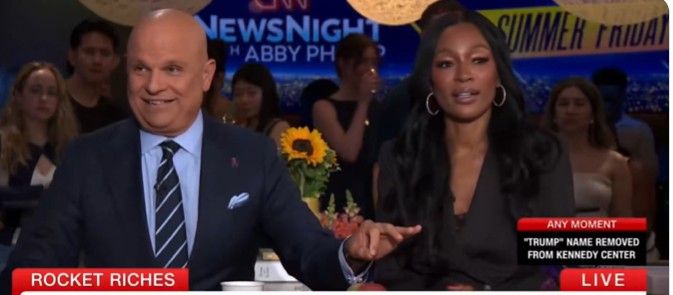
For a network that constantly lectures America about misinformation, CNN had quite a moment this week.
During a panel discussion about Elon Musk’s growing wealth and the possibility that the SpaceX founder could someday become the world’s first trillionaire, commentator Bakari Sellers casually dropped one of the most inflammatory labels in American politics.
“Elon Musk is a white supremacist who believes in things like the Great Replacement Theory.”
The reaction was immediate. “Oh, boy. Oh, boy,” exclaimed defense attorney Arthur Aidala. “You may need a lawyer when this is over,” Scott Jennings added.
In today’s legal environment, where defamation lawsuits are becoming increasingly common and increasingly expensive, casually branding one of the most famous people on Earth a “white supremacist” isn’t exactly a risk-free proposition.
Yet instead of challenging the claim, CNN host Abby Phillip appeared more interested in defending Sellers’ right to make it.
As Aidala attempted to push back, he highlighted what many conservatives see as a glaring media double standard, referencing Democratic Senate candidate Graham Platner, whose campaign was forced to address a controversial Totenkopf tattoo linked to Nazi symbolism. Platner has said he got the tattoo as a young soldier and was unaware of its historical significance before later covering it up.
Phillip interrupted to steer the conversation away from that comparison. “Bakari is arguing that he has evidence of racial bias,” she said, effectively reframing the debate from whether Sellers had recklessly applied a damaging label to whether he could justify it after the fact.
That distinction matters. The modern media’s favorite trick is to treat accusations as established facts. A conservative says something controversial? Headlines scream extremism. A Republican posts an awkward tweet? Endless analysis about dangerous rhetoric. But when a prominent left-leaning commentator labels a political opponent a “white supremacist” on national television, suddenly everyone wants a nuanced conversation about context.
Sellers doubled down. “If somebody believes in the Great Replacement Theory, I believe I have every ground to stand on.”
He then launched into a broader argument that wealthy individuals shouldn’t be shielded from criticism simply because of their money or influence. Nobody is arguing that billionaires should be immune from criticism. Musk himself is criticized every day—and he deserves some of it. The issue is something else entirely.
Accusing someone of being wrong is one thing. Accusing someone of being a racist is another. Accusing someone of being a white supremacist is among the most serious political allegations that can be made in modern America.
Those words are not substitutes for “person I disagree with.”
For years, conservatives have argued that terms like “racist,” “Nazi,” “fascist,” and “white supremacist” have been stretched so far beyond their original meanings that they’ve become little more than partisan weapons. Exchanges like this one are exactly why. What was especially revealing was how quickly the discussion shifted from whether Sellers’ accusation was appropriate to whether critics should even question it.
That’s become a familiar pattern in elite media circles. The accusation itself receives little scrutiny; the scrutiny is reserved for those who object.
Bakari Sellers DEFAMED Elon Musk on CNN labeling him a “white supremacist.” He was immediately called out by Arthur Aidala, who pointed to Democratic Senate candidate Graham Platner’s Nazi tattoo. CNN host Abby Phillip then steps in to DEFEND Sellers and attempts to *CORRECT*… pic.twitter.com/fdBgFOQZLI
— RedWave Press (@RedWavePress) June 13, 2026









nm
nm
mm