Taylor Sheridan has built a career telling stories about power, loyalty and the consequences of abandoning principles. During a recent conversation with Joe Rogan, the co-creator of Yellowstone suggested those same themes are now playing out in American politics—and he believes the long-term consequences could be far more serious than the outcome of any single election.
Yellowstone creator Taylor Sheridan perfectly encapsulates how the left’s refusal to accept Donald Trump as president is actively eroding the rule of law.
He warns that they are setting a very dangerous precedent for the future of America.
SHERIDAN: “It’s so dangerous what… pic.twitter.com/SyHFtIwJXV
— Overton (@overton_news) June 23, 2026
Sheridan argued that Americans have spent years watching confidence in major institutions steadily erode. In his view, the COVID era accelerated a collapse in public trust that extended well beyond public health and left many Americans questioning the credibility of government agencies, media organizations and even major corporations.
Reflecting on that shift, Sheridan said:
“I think in 30 years when they look back, like — we are still suffering from a society from COVID like still, and not so much from the disease itself, but from our faith in the institutions around us. Whether it’s government, whether it’s the media, whether it’s pharmaceutical companies and the way that it was manipulated to gain power for a political group, and it was effective and so when something’s effective then people just keep doing the same thing until it’s no longer effective right?”
Sheridan compared today’s political climate to strategies governments have historically used in conflicts overseas, saying the United States now finds itself wrestling with an internal struggle over legitimacy rather than an external one.
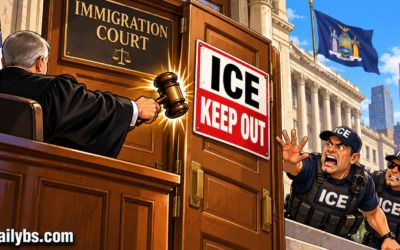
His greatest concern, however, centered on what he views as an increasing willingness by political leaders and local governments to openly resist the authority of a duly elected president.
Sheridan emphasized that his argument isn’t about whether someone personally supports President Donald Trump.
“You can like Trump or not like Trump,” he continued, noting that, “People are going to like presidents and dislike presidents, but now defying the rule of law because he happens to be the head of the federal government and openly defying the federal government. The repercussions of that are going to be, ‘Okay, fine. You can’t stand this man. You think he’s a terrible president, and you’re not going to follow his laws. But that’s the new normal now.'”
He warned that once one administration is treated as optional, future administrations could face the same resistance regardless of party.
“So when a president gets in that you do support, then the other side, because we’ve established this precedent, they’re just not going to follow his laws either,” Sheridan warned. “And now we’ve eroded the rule of law, and then what happens?”
Rogan agreed that the issue extends beyond today’s headlines. While discussing immigration enforcement, he acknowledged the difficulty of addressing illegal immigration but questioned whether expanding the visible role of heavily equipped law enforcement could establish precedents that future administrations might use differently.
According to Rogan:
“The slippery slope is very dangerous,” Rogan said, noting that while he is not in favor of illegal immigrants being in the United States, the normalization of militarized police in public life may enable the far-left once they get back into power.
He added that he was unsure whether large-scale deportations could realistically be carried out another way, given the number of illegal immigrants who entered the country over recent years, but cautioned:
“…you’re setting a weird precedent, you’re setting a precedent that can be used in other ways.”
Sheridan agreed, arguing that elected officials often focus on immediate political victories instead of considering how today’s actions may be used by tomorrow’s opponents.
“It’s slippery. It is slippery. And again, what’s good for the goose is good for the gander. And these politicians right now who are doing all of us a tremendous disservice in Washington, I feel, our elected officials, because they’re not thinking beyond this next election. And maybe they never have. But they were better at hiding it, maybe.”
Taylor Sheridan didn’t set out to make a political speech. He simply pointed out something millions of Americans have been feeling for years: trust has become the rarest commodity in the country.
COVID didn’t just leave behind empty shelves and lockdown memories. It left behind a public that watched politicians, bureaucrats, media outlets, and giant corporations speak with absolute certainty one week, only to reverse themselves the next. Then they acted shocked when Americans stopped believing them. That’s not “misinformation.” That’s human nature.
Sheridan’s bigger warning ought to make everyone in Washington uncomfortable. This isn’t really about Donald Trump. It’s about what happens when elected officials decide the rule of law only applies when their side wins. If governors, mayors, judges, and bureaucrats start treating presidential authority like an à la carte menu—follow the parts you like, ignore the parts you don’t—don’t be surprised when the other side returns the favor. Congratulations. You’ve just replaced constitutional government with political revenge.
Even Joe Rogan raised the point that today’s emergency powers often become tomorrow’s standard operating procedure. Conservatives have spent years warning that government rarely gives power back once it takes it. Whether it’s surveillance, censorship, executive authority, or heavily militarized enforcement, every new precedent eventually lands in somebody else’s hands. That’s why constitutional limits matter. They’re designed for the day your political opponents are the ones calling the shots.
The irony is rich. Many of the same voices who insisted everyone should “trust the institutions” spent the last several years undermining confidence in elections, the courts, immigration law, and the presidency whenever the outcome didn’t go their way. Trust isn’t restored through slogans or fact-check labels. It’s earned through consistency.
America survives disagreements. It’s survived ugly politics before. What it cannot survive forever is a political class that treats the Constitution like a set of suggestions whenever it’s politically convenient. The republic depends on everyone playing by the same rules—even when they don’t like who’s sitting behind the Resolute Desk.