

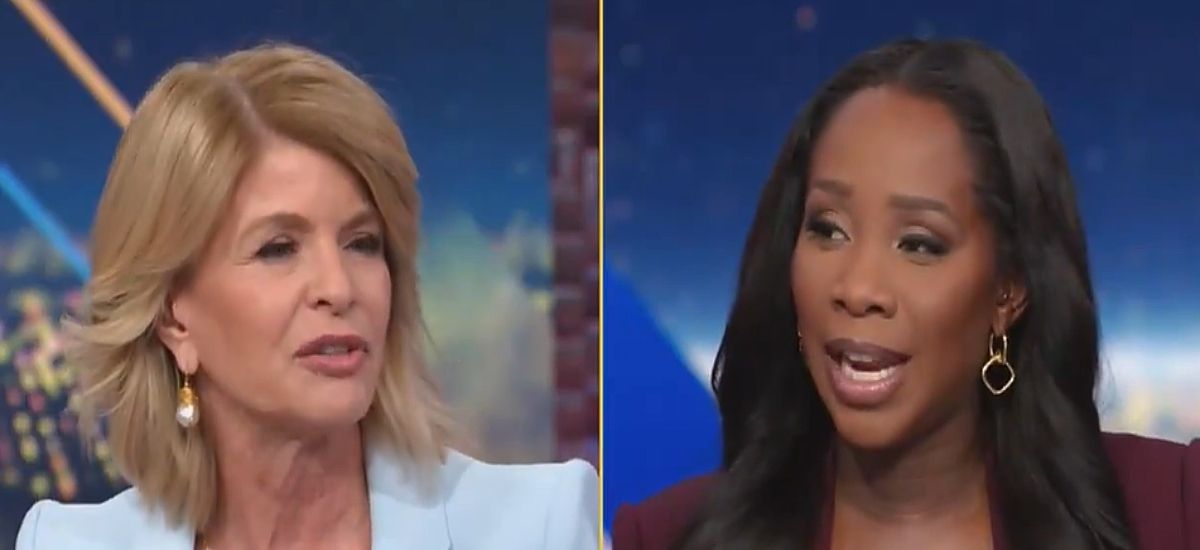
CNN host Abby Phillip burst into laughter Thursday night after a pro-Trump panelist accused Democrats of colluding with Big Tech to drive Donald Trump off the country’s largest social-media platforms.
The heated exchange began during a discussion of Trump Media’s new paid data service, which is being marketed to financial firms seeking extremely fast access to posts from influential Truth Social accounts.
Carla Sands, chair of the Foreign Policy Initiative at the America First Policy Institute, argued that Trump would never have created Truth Social without the coordinated censorship he faced from the dominant technology companies.
“He wouldn’t even have Truth Social if the Democrats hadn’t colluded with Big Tech and canceled him on Twitter, Facebook, Instagram,” Sands said. “Every single platform—he was taken down and banned while he was the sitting U.S. president.”
Phillip stopped her.
“Wait. Hold on. Wait. Democrats colluded with social-media companies when Trump was president to force them to—?”
“That’s correct,” Sands replied.
Sands: He wouldn’t even have Truth Social if the Democrats hadn’t colluded with big tech and canceled him on every single platform and banned while he was the sitting President.
Phillip: Wait, Democrats colluded with social media companies when Trump was president to force them—… pic.twitter.com/geYQW3afLg
— Acyn (@Acyn) July 24, 2026
Phillip then pointed out that Trump still controlled the executive branch when Twitter, Facebook and Instagram suspended his accounts in January 2021.
“So, remember, he was in charge of the government at the time,” Phillip said. “Just a reminder.”
Sands argued that the activity had occurred outside the president’s control.
“There was a whole hidden—there was all kinds of collusion going on behind his back,” she said, citing the intelligence community and FBI.
Phillip laughed.
“OK, so Democrats have all kinds of extraordinary powers.”
The exchange produced a tidy television moment: The CNN host laughing, the MAGA guest looking conspiratorial and the audience invited to believe the entire question had been settled by sarcasm.
The underlying record is more complicated.
Twitter permanently suspended Trump’s account on January 8, 2021, two days after the Capitol riot. The company said his posts created a “risk of further incitement of violence.”
Dorsey later said he did not celebrate the decision, but defended it as necessary under the circumstances.
“I do not celebrate or feel pride in our having to ban @realDonaldTrump from Twitter,” Dorsey wrote at the time.
He also warned that the ban demonstrated the enormous and troubling power held by a handful of private companies.
“A company making a business decision to moderate itself is different from a government removing access,” Dorsey said, while acknowledging that coordinated corporate actions could become destructive to the open internet.
Internal Twitter communications later released as part of the “Twitter Files” revealed intense debate inside the company over how to interpret Trump’s final posts. Some employees initially concluded the tweets did not clearly violate existing rules, while others argued phrases such as “American Patriots” could serve as coded encouragement for future violence.
Those disclosures raised legitimate questions about whether Twitter adapted its standards to reach a result its most politically engaged employees wanted.
They did not, however, publicly establish that Democratic Party officials ordered Twitter to ban Trump on January 8.
That distinction matters.
Sands’s broader point—that political and government pressure has influenced Big Tech censorship—is supported by a far more extensive paper trail arising from the Biden years.
A 2024 House Judiciary Committee report, based on subpoenaed communications and internal company documents, concluded that Biden administration officials pressured Facebook, YouTube, Amazon and other companies over speech involving COVID-19, vaccines and administration critics.
The committee alleged that platforms changed moderation policies in response to White House demands and that even truthful information and satire were caught in the censorship machinery. Those findings were issued by the Republican-led committee and remain politically disputed, but the communications at the center of the investigation were real.
The Supreme Court later considered a challenge to Biden administration contacts with social-media platforms in Murthy v. Missouri.
In a 6-3 ruling, the court held that the challengers had not demonstrated the standing required to obtain an injunction. The majority did not issue a sweeping declaration that every government communication with the platforms had been harmless or constitutionally proper.
The immediate CNN discussion was triggered by a different controversy, Trump Media’s plan to sell its Truth API to professional traders.
The company describes the service as providing the fastest access to posts from Truth Social’s most influential accounts. Published reports say trading firms are paying as much as $100,000 per month to ingest posts rapidly into automated systems that can react to market-moving language within milliseconds.
Critics argue the service could give wealthy institutional traders an advantage over ordinary investors whenever Trump makes statements affecting stocks, commodities or entire industries.
Sen. Mark Warner reportedly described the arrangement as self-dealing and raised concerns about market integrity. Trump Media maintains it is selling rapid access to information that becomes public rather than providing secret government information.
Even some market analysts have questioned how consistently valuable the service will be. JPMorgan researchers examining bond markets reportedly found that most Trump posts produced little measurable short-term movement, though occasional statements still caused sharp reactions.
That debate continued around Phillip’s table Thursday night, but it was Sands’s allegation about censorship that supplied the viral moment.
MY TAKE:
First, let’s clean up Carla Sands’s argument, because conservatives do ourselves no favors when we claim two miles more than the evidence will carry us.
Do we have proof that a secret meeting of Democratic officials ordered Jack Dorsey to ban Donald Trump on January 8, 2021?
No.
Twitter made that decision while Trump was still president. The company publicly owned it. Dorsey personally defended it, even while admitting that concentrating this much control over public speech in the hands of a few Silicon Valley corporations was dangerous.
That is the factual record.
But Abby Phillip’s reaction was its own little masterpiece of cable-news dishonesty.
Laugh. Roll the eyes. Act as though government officials pressuring Big Tech is so preposterous that only someone wearing a tinfoil cowboy hat could believe it.
Really? Where has CNN been?
We have emails. We have sworn testimony. We have internal company messages. We have years of documented contact between government officials, federal agencies and technology executives concerning what Americans were saying online.
The Biden White House complained about content it wanted removed. Officials demanded faster action. Platforms changed rules. True material, satire and political argument got swept into systems supposedly designed to stop “misinformation.”
But Abby laughed, ladies and gentlemen. Case dismissed! Apparently laughter is the new fact-check.
This is one of the media’s favorite tricks. Take an assertion that is phrased too broadly, ridicule the entire subject and pretend the underlying scandal never existed.
Did powerful Democrats and federal officials spend years leaning on Big Tech to suppress disfavored speech? There is enough documentation to fill a warehouse.
When conservatives are censored, it is content moderation. When liberals face criticism, it is a constitutional crisis.
And then there is the delicious irony of Truth Social.
Trump was thrown off the major platforms, built his own, returned to the White House and now has Wall Street firms reportedly paying enormous sums for faster access to his posts. The people who tried to make him disappear helped create a competing media company worth billions.
That may be the most Trumpian business story ever told.
Ban the man. He builds the platform. Mock the platform. The platform starts selling data to Wall Street. Then CNN convenes a panel to complain that the platform exists.
You could not script it better.
Now, is charging traders $100,000 a month for millisecond-speed access to potentially market-moving presidential posts a great look?
Not especially.
Ordinary Americans are entitled to ask whether the president’s public pronouncements should become a premium feed for hedge-fund computers capable of buying and selling before a guy in Queens has finished opening the app.
That is a serious ethical question, and Republicans should not be afraid to ask it merely because Trump’s name is involved.
But that discussion does not rewrite the history of Big Tech censorship. Trump did not wake up one morning and create Truth Social because he had always dreamed of becoming the next Mark Zuckerberg. He created it after the digital town square locked its doors, turned off the lights and informed the sitting president of the United States that he was no longer invited.
Abby Phillip may find the censorship record hilarious. Millions of Americans who watched their opinions throttled, labeled, buried and banned are not laughing.
DBS WIRE SOURCES:
- Mediaite — CNN’s Abby Phillip bursts out laughing as MAGA panelist claims Dems ‘colluded with Big Tech’ to ban Trump
- CNN — NewsNight transcript: Panel debates Truth Social, Big Tech and Trump’s platform bans
- Trump Media & Technology Group — Trump Media launches Truth API
- The Wall Street Journal — Why Wall Street firms are paying $100,000 a month for a fast track to Trump posts
- Associated Press — Paying for early access to Trump’s Truth Social could raise big money—and major ethical issues
- Time — Trump Media to sell traders the fastest access to Truth Social posts
- House Judiciary Committee — Report details Biden White House pressure on Big Tech platforms
- Supreme Court of the United States — Murthy v. Missouri opinion
- Jack Dorsey — Statement explaining Twitter’s decision to suspend Donald Trump










Maybe barrow a page from the Liberal (Socialist/Communist/Progressive) Playbook… and NATIONALIZE theses Corporations in the name of National Security! Seize their bank accounts to “Balance the Budget”. Then see what happens… Just a daydream.
12