BS BRIEF:
- Post Modern Times, a South Minneapolis restaurant that removed its menu prices and began serving free, donation-supported meals during the federal immigration enforcement operation known as Operation Metro Surge, has temporarily closed after six months. Owner Dylan Alverson says the café needs several weeks to rebuild its finances, staffing and operating system.
- The restaurant says it served more than 30,000 meals while receiving roughly 2,000 donations, but acknowledged that it exhausted its winter donations, strained the building’s capacity and at times overwhelmed the surrounding neighborhood.
- The ambitious experiment attracted national praise as an alternative to the traditional restaurant model. Its abrupt pause now offers a less romantic lesson about limited resources, paying customers and the burden a private business can place on its neighbors when demand becomes effectively unlimited.
MINNEAPOLIS FREE-FOOD EXPERIMENT CLOSES AFTER MONEY AND NEIGHBORHOOD PATIENCE RUN LOW
MINNEAPOLIS — A South Minneapolis restaurant that tried to prove meals could be free has temporarily closed after learning that the food, labor, space and neighborhood consequences were not.
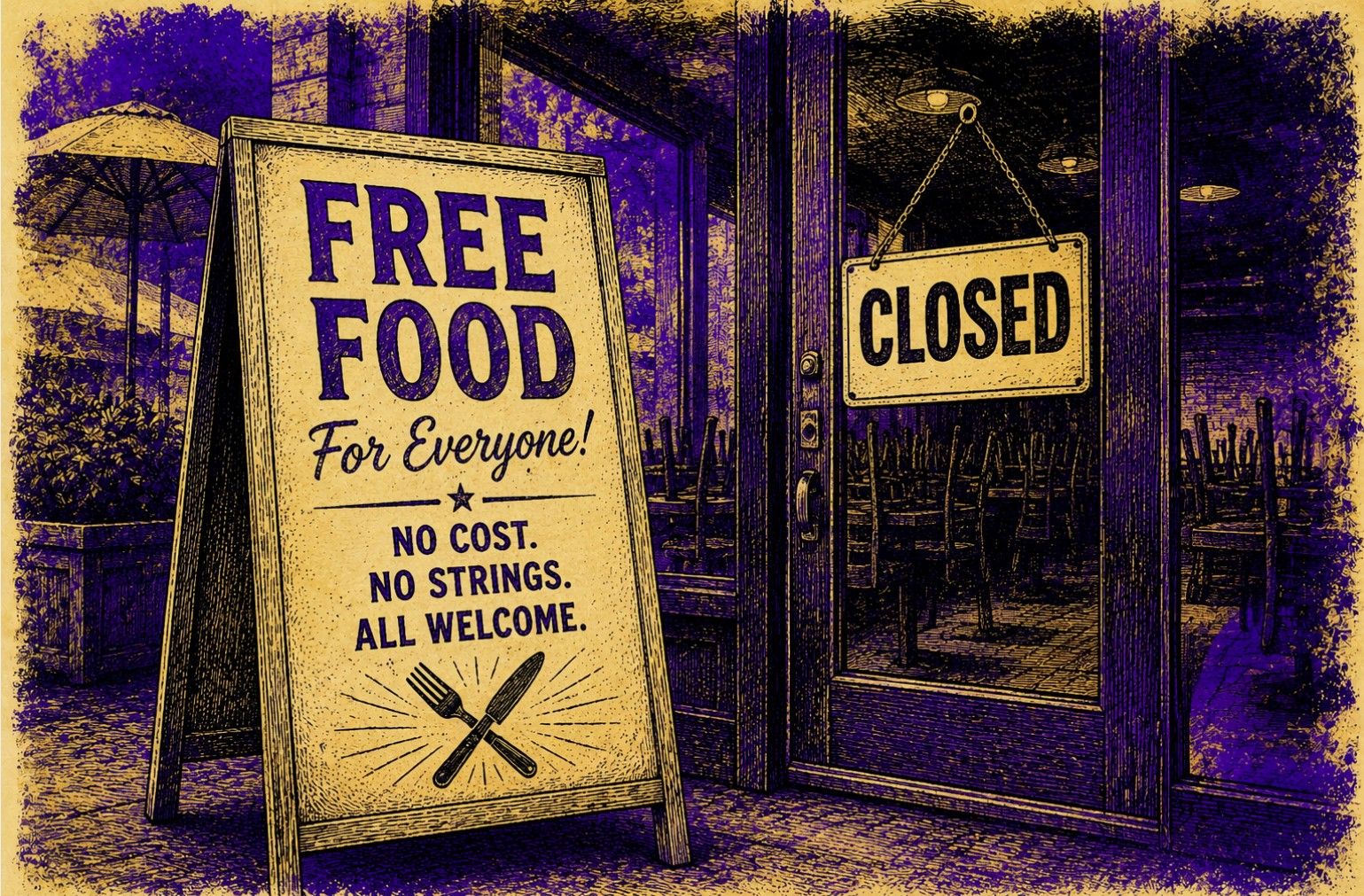
Post Modern Times stopped putting prices on its menu six months ago and began feeding virtually anyone who entered, whether that person donated or not. The restaurant’s owner, Dylan Alverson, originally framed the switch as a protest against federal immigration enforcement and the sales taxes his business would otherwise collect for the government.
For a while, the experiment became a national media darling.
Stories celebrated a restaurant that appeared to be thriving without traditional prices. Alverson said donations had initially improved the café’s financial condition, while supporters held up the model as proof that generosity and community support could replace the usual exchange between a business and its customers.
But six months and more than 30,000 meals later, reality walked in and asked for a table.
The restaurant announced that it was closing temporarily and would spend the next several weeks developing a new system—one that could continue providing some free food without pushing aside paying customers, burning through contributions or overwhelming the block.
In its announcement, the restaurant wrote:
“We have served over 30,000 meals with over 2,000 donations.”
Then came a memorable description of its present condition:
“We feel like an over hard egg on the sidewalk without a fork or hot sauce.”
The statement continued:
“We knew this wasn’t going to be easy and we have exhausted ourselves, our winter’s donations, our building’s capacity, and at times our neighborhood.”
The owners said the project began “as a protest” and continued “as a promise to keep feeding people with your donations.”
The café sits near Chicago Avenue and East 32nd Street, where demand for free meals quickly grew beyond the restaurant’s physical capacity.
The large crowds reportedly displaced many of the café’s longtime neighborhood customers. Waits stretched for hours, leaving groups gathered around the intersection six days a week. The Minnesota Star Tribune reported that neighbors complained of crowding and antisocial behavior surrounding the business.
The restaurant’s success at attracting people in need became part of its operational problem.
When a meal had no required price, demand no longer depended on whether someone could afford—or even particularly wanted—the product. The café became a food-distribution operation, community center, political protest and restaurant all at once.
It did not have the space or infrastructure to perform all four jobs indefinitely.
Alverson said the pause was intended, in part, to:
“Give everyone some rest.”
That apparently includes the employees, volunteers, diners and neighbors who spent six months living beside the experiment.
Earlier accounts of the restaurant’s model painted an almost miraculous financial picture.
Alverson said the conventional café had produced approximately $1.3 million in annual sales but struggled under rising food, labor and maintenance costs. After prices disappeared, national publicity and sympathetic donors reportedly poured hundreds of thousands of dollars into the operation.
One July account said roughly 90% of meals were being served without an accompanying donation, even as outside contributions allowed the café to pay workers and provide Alverson a salary.
That arrangement depended less on restaurant customers paying for meals than on donors elsewhere subsidizing them. Once those donations slowed, the limits became impossible to ignore. The restaurant now has a fundraiser seeking $750,000 to support its next phase, according to the Minneapolis/St. Paul Business Journal.
Post Modern Times has not announced a permanent shutdown. Its social media pages describe the closure as temporary and say the café will remain closed “until further notice” while organizers develop a more sustainable structure.
The revised model is expected to preserve some free meals while creating enough room for customers who are willing to pay. The restaurant must also address the practical problems created by long lines, a small building and persistent neighborhood complaints.
In other words, the next version could look less like unlimited free dining and more like a conventional restaurant with a charitable meal program attached.
That may lack the revolutionary branding. It may also have a better chance of surviving.
DBS WIRE SOURCES:
- Minnesota Star Tribune — The Post Modern Times took prices off the menu. Neighbors say they paid a price
- Minneapolis/St. Paul Business Journal — Post Modern Times temporarily closes, restructuring its pay-what-you-can model
- Business Insider — I couldn’t make my restaurant’s numbers work. So I took prices off the menu
- Food & Wine — This pay-what-you-can café offers a new playbook for restaurants
- People — Minnesota restaurant stops charging customers for food—and says business is thriving