BS BRIEF:
- The Smithsonian’s National Museum of American History still displays Dr. Anthony Fauci’s signed Washington Nationals cap beside text portraying him as a trusted scientific voice battling “misinformation and denial” during the pandemic.
- The exhibit remains unchanged as Fauci faces renewed scrutiny over newly released pandemic diaries and a July 29 Senate hearing where he invoked the Fifth Amendment more than 100 times rather than answer questions about COVID origins, federal research funding and his public statements.
- A national history museum should preserve artifacts, not freeze disputed public officials inside flattering narratives that ignore the controversy surrounding them.
FAUCI PLEADS THE FIFTH WHILE THE SMITHSONIAN KEEPS HIS HALO POLISHED
Dr. Anthony Fauci’s ceremonial first pitch was not especially close to home plate. His place in the Smithsonian, however, is apparently right down the middle.
The National Museum of American History’s sprawling “Entertainment Nation” exhibition continues to feature a Washington Nationals cap signed and worn by Fauci when he threw the opening pitch before Major League Baseball’s pandemic-delayed 2020 season.
Beside it is a placard that presents the former federal health official as the steady scientific voice who helped guide professional sports through a dangerous national emergency.
“As a deadly pandemic ravaged the nation, major sports leagues found themselves at the center of a debate over ‘reopening’ the country,” the museum text reads.
It continues: “Amidst a cacophony of misinformation and denial, advice from Dr. Anthony Fauci, the nation’s leading epidemiologist, urged leagues to make decisions about resuming play ‘based on scientific evidence and public health judgment.’”
The placard concludes by noting that when baseball returned, Fauci delivered the ceremonial opening pitch “wearing a facemask in a stadium empty of fans.”
That is one way to tell the story. It is also the version most likely to appear in a screenplay titled Saint Anthony of Bethesda.
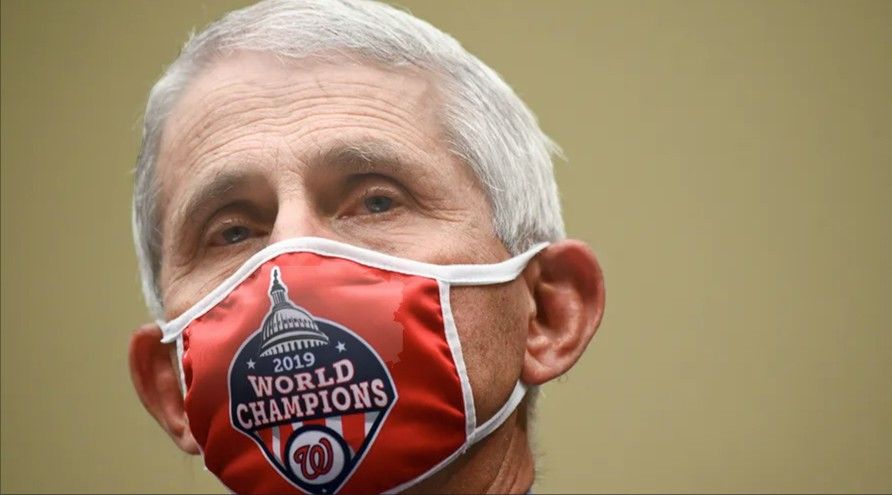
The museum’s artifact record is similarly reverential, describing Fauci as an “infectious disease superstar.” The Smithsonian previously honored him with its “Great Americans” medal and accepted several pandemic-related objects from him, including his Nationals mask and a three-dimensional model of the coronavirus.
Museums are supposed to collect historically significant objects. Fauci’s cap qualifies.
He was one of the most recognizable public officials of the pandemic. His opening pitch symbolized the deeply strange return of professional sports before empty seats, cardboard fans and television audiences trapped at home.
The problem is not the cap. The problem is the halo.
The exhibit describes “misinformation and denial” without acknowledging that some positions dismissed or suppressed during the pandemic later became subjects of legitimate scientific and governmental investigation.
It says nothing about the continuing dispute over whether COVID-19 emerged naturally or through a laboratory-related incident.
It says nothing about U.S. funding that passed through EcoHealth Alliance to the Wuhan Institute of Virology.
It says nothing about Fauci’s clashes with Sen. Rand Paul over whether that research met the federal definition of gain-of-function work.
It says nothing about lockdown damage, school closures, shifting mask guidance, vaccine mandates or the millions of Americans who believe public-health authorities overstated certainty while punishing dissent.
Instead, visitors get a baseball cap and the comforting assurance that Fauci represented science while his critics represented misinformation.
That narrative has become considerably harder to sustain.
Fauci appeared Wednesday before the Senate Homeland Security and Governmental Affairs Committee, now chaired by Paul, for a hearing devoted entirely to his conduct and testimony.
Rather than engage in another televised scientific duel with the Kentucky senator, Fauci repeatedly invoked his Fifth Amendment right against self-incrimination.
He refused to answer more than 100 questions. Multiple outlets counted 111 invocations.
Fauci said in his opening statement that the proceeding was a political trap designed to manufacture grounds for prosecuting him. “I believe that Senator Paul has brought me here today not to seek truth, but to create an opportunity to charge me with a crime,” Fauci said, according to reports from the hearing. His attorneys have argued that Republican threats of perjury and contempt charges created a genuine risk despite the sweeping preemptive pardon President Joe Biden issued before leaving office.
Paul treated Fauci’s silence as another form of obstruction.
The senator is now pursuing a contempt referral and argues that Fauci cannot selectively offer a prepared defense and then refuse to answer every substantive question that follows. Whether that effort produces criminal charges remains deeply uncertain: a committee recommendation, Senate action and Justice Department involvement would all be required, while courts could eventually have to address whether Fauci retained a valid Fifth Amendment claim after receiving a pardon.
Fauci’s defenders called the hearing political theater. More than 150 scientists signed a letter supporting him, and Democrats accused Paul of conducting a vendetta against a public servant who faced death threats while helping lead the country through an unprecedented crisis. The Associated Press noted that Paul presented no new scientific evidence resolving the still-disputed question of COVID’s origin.
Days before the hearing, Paul released more than 1,000 pages of Fauci’s pandemic-era diary entries.
The documents reveal a man operating at the center of government, media and celebrity culture during the largest public-health emergency in generations. They also reveal a figure highly conscious of his own fame.
In one May 2020 entry, Fauci wrote that his “national and international fame is explosive and really unimaginable,” adding that it was “not hyperbole” to describe himself as perhaps the most famous and discussed person in the country.
The diaries include his private conversations with presidents, governors, reporters, celebrities and public officials. They also show Fauci collecting and commenting on flattering coverage while expressing fury at critics and frustration with Trump administration officials.
The diaries also revived the argument over lockdowns. Fauci rejected claims that he personally ordered the country to shut down, accurately noting that state and local leaders possessed the legal authority to close businesses and schools. Yet his diary entries show him recognizing that officials in major cities were following his recommendations and viewing their shutdown decisions as responsive to his advice. That does not mean Fauci personally signed every closure order. It does mean the museum’s clean separation between Fauci’s “scientific evidence” and everybody else’s “misinformation and denial” looks less like history and more like public relations.
The origin debate is equally complicated.
Fauci has long argued that available scientific evidence points toward natural animal-to-human transmission. Many scientists continue to support that explanation.
Several federal intelligence agencies, however, have assessed with varying degrees of confidence that a laboratory-associated origin is plausible or more likely. Others remain undecided or favor natural emergence.
The public record also shows that Fauci and other officials discussed the possibility of laboratory involvement privately during the opening weeks of the pandemic, even as public messaging increasingly emphasized natural origin and treated some lab-leak claims as conspiracy theories.
That is not proof that Fauci created the virus, funded its creation or orchestrated a cover-up. It is proof that the history is unsettled. And unsettled history should not be presented as a morality play with one heroic scientist standing against a faceless “cacophony” of ignorant people.
The Fauci display has emerged in the middle of a much larger fight over the Smithsonian’s direction.
President Donald Trump issued a July 24 executive order directing federal officials to install signs on National Park Service-controlled sidewalks outside the National Museum of American History. The signs are intended to warn visitors that the administration considers some museum displays inaccurate or ideologically slanted and to direct them to alternative historical material.
The order followed a White House report released July 4 accusing museum leaders of promoting an uninspiring and politically distorted version of the American story. The administration cannot simply rewrite the Smithsonian’s displays by decree. The institution has a distinct governing structure and is overseen by a Board of Regents rather than operating as a normal executive-branch agency.
That is why the White House’s latest order targets surrounding federal property and calls for competing signs and temporary exhibits instead of directly ordering the museum to remove objects. Trump has called the Smithsonian “woke” and “OUT OF CONTROL.” White House official Lindsey Halligan told Fox News Digital that taxpayers should not be financing “one-sided, divisive political narratives.” “The Smithsonian Institution should present history in a way that is accurate, balanced, and consistent with the values that make the United States of America exceptional,” Halligan said.
National Museum of American History Director Anthea Hartig rejected the administration’s characterization during a July 22 congressional hearing.
Hartig defended the museum’s scholarly standards and said its purpose is to present a broader American story, including people and experiences previously neglected by national institutions.
She also pointed to major patriotic artifacts and exhibits, including Thomas Jefferson’s writing desk and the original “Star-Spangled Banner,” as evidence that the museum has not abandoned the nation’s founding or achievements.
Hartig called the White House report unfair and inaccurate. That disagreement is itself part of the story.
The Smithsonian receives enormous taxpayer support. Its curators wield significant cultural power. Their labels do not merely display objects; they tell millions of visitors how to understand those objects.
When a placard uses loaded language such as “misinformation and denial,” it makes a judgment.
When it depicts Fauci as the uncontested voice of evidence and public-health reason, it makes a judgment.
When it omits the controversies now central to his public legacy, it makes a judgment.
DBS WIRE SOURCES:
- Fox News — ‘Woke’ Smithsonian exhibit lionizes embattled Fauci amid conservative scrutiny of museum’s messaging
- Smithsonian National Museum of American History — Entertainment Nation
- Smithsonian National Museum of American History — Washington Nationals cloth face mask signed by Dr. Anthony Fauci
- Associated Press — Fauci repeatedly invokes the Fifth Amendment in contentious Senate hearing
- Reuters — Could Fauci face criminal charges for refusing Senate COVID questions?
- CBS News — Fauci diaries touch on COVID origins and tense relationship with Trump
- Forbes — Fauci’s diary: What he said about Trump, his own fame and COVID restrictions
- Senate Homeland Security Committee — Testimony of Anthony Fauci
- White House — Restoring Trust in the Smithsonian Institution
- White House — Saving America’s Story: Smithsonian report
- Associated Press — Trump orders signs outside Smithsonian saying some exhibits are inaccurate
- Associated Press — Smithsonian history museum chief rejects White House criticism