(The Center Square) – California’s ethics agency oversees an unlimited, blank-check system of payments solicited by elected officials — including the $347 million Gov. Gavin Newsom has steered through California politics. An investigation by The Center Square has found the state’s “transparency” portal shows the money, but it omits the conflicts of interest.
Voters using the database have no way to search whether donors had business before the government at the time of their donations, even though that information is collected by the California Fair Political Practices Committee (FPPC).
The omission matters because California caps campaign checks. It does not cap “behested payments.” State law allows elected officials to solicit unlimited sums of money from corporations, unions, tribes, foundations and other special interest groups — so long as the money goes to a third party instead of a campaign account.
That means a donor who would otherwise be limited to $39,200 per election for a governor’s campaign can give millions more to a nonprofit, public project, or outside cause if the money is solicited by that same official and reported as a behested payment.
“It’s another way of trying to influence government,” explained Richard Briffault, a Columbia University law professor and campaign finance expert. “It’s another deposit in the favor bank. That doesn’t necessarily mean there will be a quid pro quo… Occasionally, there might be a real connection. Then that can be criminal. But usually? If they’re buying anything, they’re buying goodwill. They’re buying a favorable disposition.”
The FPPC’s database only reveals behested payments involving state officials. Cities and counties are tasked with managing their own behested-payment data.
Unlike the state database, some cities like Los Angeles, San Diego, San Jose, Sacramento, and Long Beach post full disclosure forms online that include any conflicts of interest for the public to review.
Connecting the dots
California’s FPPC was born from a demand for transparency. Voters created the agency in 1974 in the wake of the Watergate scandal to shine light on political money and government ethics.
Even if donors have a contract or proceeding before the government, state law does not prohibit them from donating unlimited sums of money to a third party at a politician’s behest. Instead, the FPPC relies on disclosure to inform the public.
Elected officials are required to fill out a Form 803 within 30 days for each behested payment once they total $5,000 or more in a calendar year. The document includes a box for politicians to check if the donor is “a named party or the subject of a proceeding before (the official’s) agency.”
The form also provides half of a line for a brief description.
The FPPC has previously acknowledged this is information “that the public would want to see.”
“The purpose of the behested payment reporting scheme is to allow for payments that serve the public good, and to provide disclosure when there is a potential for influence over an elected official,” wrote FPPC general counsel David Bainbridge in 2021.
But the form itself is not uploaded to the FPPC’s database.
Instead, employees of the FPPC input details from the form such as donor (payor), recipient (payee), and dollar amount. The FPPC omits any information about whether donors have outstanding government business; “Copies of the full reports are available at the FPPC office in Sacramento.”
FPPC Communications Director Shery Yang failed to respond to multiple requests for comment from The Center Square since July 15. Staff have not answered why the information is collected but left unpublished.
Sean McMorris, who manages the transparency and ethics program for California Common Cause, said he was disappointed to see an FPPC “transparency” portal concealing the most important information from voters.
“They should be accurately extracting and putting that information into that spreadsheet,” McMorris said. “(Disclosure) is absolutely essential to a well-functioning democracy, because journalists can take this information. They can connect dots and let the public decide if something is appropriate or not.”
Briffault said it can be extremely difficult for members of the public to follow money when key details are not made public.
“It’s the connecting of dots that’s the problem. Just getting the dots can be difficult for most people, but linking them up, I think, is the hard part,” Briffault said. “That’s kind of up to you all. The media are going to be the ones that are hopefully tracking this.”
‘really unfortunate examples’
Sen. Brian Allen, D-Santa Monica, is the most recent state lawmaker to pass reforms to California’s behested-payment system.
Senate Bill 760 went into effect on January 1, 2026. The bill stopped lawmakers from being required to disclose donations made at their behest if the payment results from a “public appeal” such as a television broadcast, radio broadcast, billboard or public online message.
Allen said the bill was spurred by tricky conversations with lawyers telling him not to publicly mention the names of helpful nonprofits in the aftermath of the Palisades Fire.
“I was advised I shouldn’t mention any of these really amazing organizations that were helping in the community. These are organizations that I have no personal connection to besides gratefulness,” Allen said. “That just seemed insane to me.”
SB 760 also codified some of the FPPC’s existing regulations. Allen said it was important for him to ensure elected officials would still be required to disclose behested payments in cases of perceived conflicts of interest.
“If your family or your staff hold a prominent position within the (recipient) organization, that’s a different story. We really want to make sure there’s not even the remotest appearance of self dealing,” Allen said. “The reason why we have these rules in place is to make sure elected officials aren’t appealing for donations for their own private gain or the gain of someone very close to them. A spouse. A family member. Maybe a staffer. I completely understand all of that. I know there have been some really unfortunate examples of that over the years.”
FPPC records show Newsom has solicited 42 payments from 23 donors totaling $4.28 million for California Partners Project, a nonprofit founded by First Partner Jennifer Siebel Newsom. Attorney General Rob Bonta solicited more than $517,000 from four donors for two nonprofits employing his wife Mia Bonta when he was a member of the California State Assembly.
Allen did not elaborate on the “really unfortunate examples.” He did not mention Newsom, Bonta, or any other elected official by name.
Overall, Newsom has used California’s behested-payment system far more aggressively than any other elected official in state history, soliciting more than $347 million from businesses and wealthy individuals to various causes since becoming lieutenant governor in 2010. The next-highest total belongs to former Gov. Jerry Brown, who reported about one-tenth as much money or approximately $35 million.
The FPPC requires disclosure, and Newsom has been fined on multiple occasions for not filing timely reports.
Records show Blue Shield of California and its affiliated entities have donated more than $21 million at the request of California’s elected officials. It was one of the 23 donors that contributed to the first partner’s nonprofit at Newsom’s request.

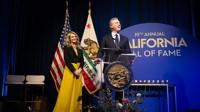
California Gov. Gavin Newsom and first partner Jennifer Siebel Newsom at the California Hall of Fame ceremony, March 19, 2026. Photo: Office of California Governor / Courtesy of the Office of the Governor
Blue Shield’s largest donation of $20 million was in 2020 to Enterprise Community Partners, also at the request of Newsom.
The health insurance provider donated twice to the Governor’s Inaugural Fund to support Newsom’s inauguration in 2019 and 2023. Those donations totaled $175,000.
Blue Shield was actively and consistently lobbying the Governor’s Office during California’s 2019-2020 legislative session, according to records from the California Secretary of States’ Office. The company spent $1,517,760.26 during that session on its lobbying efforts.
In 2021, Newsom awarded Blue Shield a $15 million, no-bid contract to take over California’s COVID-19 vaccine network.
Due to omitted information on the FPPC portal, it’s unknown whether any of Blue Shield’s state business was disclosed at the time of its behested payments. The Center Square has filed a request for the actual disclosure forms, but the FPPC has not provided them as of publication.
Blue Shield has consistently donated to Newsom’s campaigns since he was a member of the San Francisco Board of Supervisors in 2002.
“If you’ve tapped out? If you’ve given the maximum that you can to a particular candidate? You can instead curry favor with them by contributing to their favorite donation,” McMorris said. “The politicians know very well who to go to. They’re not calling up an average person. They’re going to someone with a lot of money and someone who they know needs something from them.”
No interview, just statement
Newsom has not responded to interview requests from The Center Square.
Instead, a spokeswoman for Newsom emailed a statement broadly characterizing behested payments as “a lawful, bipartisan tool to support charitable and public-service efforts that benefit Californians (and that might otherwise be borne by taxpayers).”
“Californians deserve transparency, accountability, and confidence that charitable giving serves the public interest,” wrote Diana Croft-Pelayo, the governor’s chief deputy director of communications.
Mark Seelig, a spokesman for Blue Shield, declined an interview request from The Center Square and refused to answer questions related to Blue Shield’s government business at the time of its behested payments.
“We regularly support candidates for public office from both major political parties who share our mission of improving healthcare access and affordability,” Seelig wrote in an email. “Our contributions are fully and properly disclosed according to applicable laws.”
Allen said he was surprised to learn the FPPC doesn’t disclose details about donors with government business. He said he didn’t want to speculate on the reason.
“They should do it. I agree,” Allen said. “Presumably they could certainly figure out a way.”