

Iran is now directly challenging President Donald Trump’s declaration that the United States has “total control” of the Strait of Hormuz, even as commercial traffic through the critical oil corridor remains a fraction of its prewar level.
Hossein Taeb, a senior commander in Iran’s Basij paramilitary force, declared Thursday that the waterway remains “under Iran’s control and management,” according to Iran’s semi-official Fars news agency and Reuters.
His statement came one day after Trump again claimed American dominance over the strait.
“We totally control the Strait of Hormuz,” Trump told reporters. “We have control over it. Nobody else. Only us. Our Navy is unbelievable, and things are going great for our country.”
Tensions remain high in the Middle East with no diplomatic breakthrough in sight.
Iran insists the Strait of Hormuz will remain blocked until its conditions are met, while President Trump says the U.S. has “total control” of the critical waterway.@TreyYingst breaks down the… pic.twitter.com/GDRLp6vpQS
— Fox News (@FoxNews) August 13, 2026
Trump later amplified the claim on Truth Social, describing the American naval presence as a “WALL OF STEEL” and insisting there was “nothing Iran can do about it.”
“Their country is ‘shot,’” Trump wrote. “All they have is FAKE NEWS and 300% INFLATION, and getting worse! Iran is all talk and no action, the Bully of the Middle East No Longer. Praise be to Allah!”
The United States may possess overwhelming military power in the region, but that is not the same thing as restoring normal commercial traffic. The ships—and the energy markets—are telling a considerably messier story.
Fox News anchor Bret Baier drew attention Wednesday night to the stark gap between Trump’s language and the shipping data.
“Despite President Trump claiming total control over the strait, traffic has slowed, really, to a trickle,” Baier reported on Special Report.
Before the war, more than 100 vessels routinely crossed the strait each day. According to the figures presented by Baier, only eight ships crossed Monday and 14 crossed Tuesday.
The Wall Street Journal reported Thursday that traffic previously averaged more than 130 vessels per day and that many shipowners continue avoiding the U.S.-protected corridor near Oman because of Iranian missiles, drones and prohibitive war-risk insurance costs.
Some vessels reportedly continue traveling through Iran-controlled routes, while others switch off their tracking systems to make their movements harder to follow.
That does not necessarily prove Iran has military command of the entire waterway. It does demonstrate that the United States has not yet created the conditions required for ordinary commercial shipping.
The Strait of Hormuz is the gateway between the Persian Gulf and the open ocean. Nearly 21 million barrels of petroleum products passed through it each day during the first half of 2025—roughly 20% of global petroleum-liquids consumption. About one-fifth of the world’s liquefied natural gas trade also normally moves through the passage.
The U.S. Energy Information Administration now estimates that oil and petroleum shipments through Hormuz averaged only 4.9 million barrels per day during the second quarter of 2026, down from 21.6 million during the final quarter of 2025.
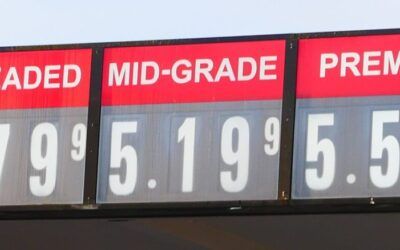
Because of those constraints, the EIA raised its projected average price for Brent crude in 2026 from $82 to $87 per barrel. It also increased its full-year retail gasoline forecast by 14 cents, to $3.78 per gallon.
“We estimate that global oil inventories fell by an average of 4.2 million barrels per day in the second quarter,” the agency said, forecasting an additional average decline of 3.8 million barrels per day during the third quarter.
The International Energy Agency’s August report delivered another warning. Global observed oil inventories fell by 69 million barrels in July and have dropped by approximately 410 million barrels since the war began.
The IEA now expects a third-quarter global supply deficit of 1.8 million barrels per day—more than double its previous projection.
The latest dispute over who “controls” Hormuz comes as efforts to revive the short-lived June interim agreement between Washington and Tehran appear to have gone nowhere.
An Iranian source told Reuters that negotiations have made “absolutely no progress.” Washington has accused Tehran of refusing to reopen the strait. Iran maintains that the United States failed to lift port restrictions and release frozen Iranian assets as promised.
Trump declared the agreement “over” on July 7, and Iran formally suspended its participation shortly afterward.
WIRE SOURCES:
- Mediaite: Bret Baier undercuts Trump’s Iran claim as traffic slows “to a trickle”
- Reuters: Iran says the Strait of Hormuz is under its control
- Reuters: Trump says the United States has “total control” over Hormuz
- Wall Street Journal: Trump says Hormuz is under U.S. control—but few ships are listening
- U.S. Energy Information Administration: August Short-Term Energy Outlook
- International Energy Agency: August 2026 Oil Market Report
- Reuters: No progress toward reviving the U.S.-Iran interim agreement









Iran’s purpose in life now is to destroy PDJT’s credibility. And PDJT is just trying to make sure the loss of life is as low as can be.