

BS BULLETIN:
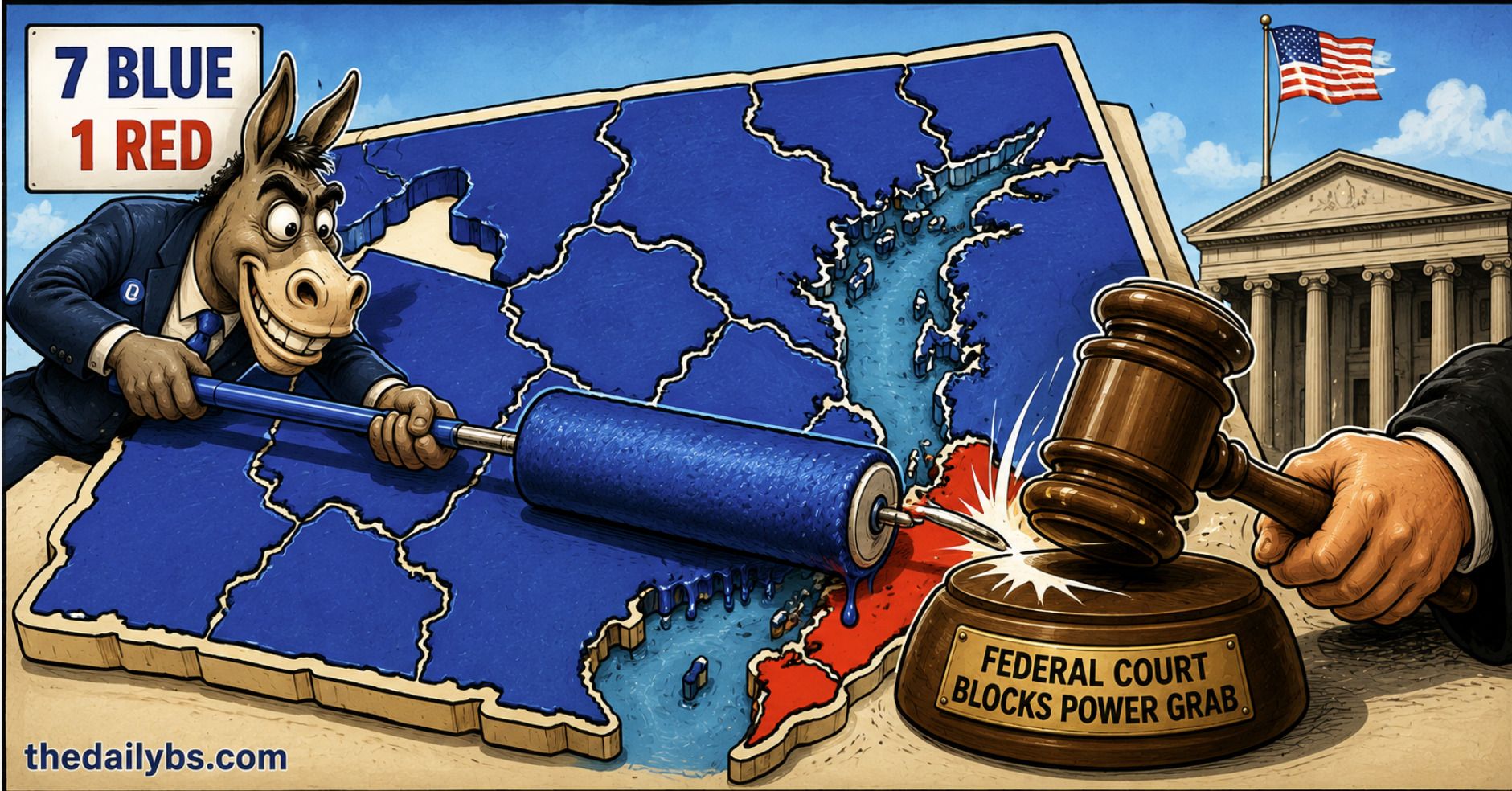
- Maryland Democrats called a special session and pushed through a constitutional amendment that could clear the way to redraw Republican Rep. Andy Harris out of his seat.
- Judge Robert Thompson ruled Wednesday that lawmakers failed to follow their own election law — and called the wording they wanted voters to see “intentionally misleading.”
- Democrats aren’t finished: Thompson stayed his ruling while the state appeals, putting the fate of the November ballot question in the hands of Maryland’s Supreme Court.
Maryland Democrats already control seven of the state’s eight congressional seats.
Apparently 7-1 was just intolerably bipartisan.
Their effort to make it 8-0 hit a rather substantial pothole Wednesday when an Anne Arundel County judge blocked a proposed constitutional amendment from appearing on November’s ballot.
And Judge Robert Thompson didn’t merely find some obscure typo.
He concluded lawmakers hadn’t followed their own law — and that the ballot language they planned to put before Maryland voters was “intentionally misleading.”
That’s quite a review.
The fight centers on Republican Rep. Andy Harris, chairman of the House Freedom Caucus and the sole surviving Republican in Maryland’s eight-member congressional delegation.
Democratic Gov. Wes Moore called lawmakers back to Annapolis for a special session this month as Maryland joined the nationwide mid-decade redistricting war.
Moore wasn’t coy about why Maryland needed to act.
“For over a year, I have warned that Donald Trump and Republicans across the country are working to rig the system,” Moore said after lawmakers approved the amendment.
“Maryland will not be caught flat-footed.”
The Democratic plan was clever.
Maryland’s Constitution contains requirements that districts be compact and respect natural boundaries. Those rules helped kill Democrats’ previous congressional map in court in 2022.
So lawmakers proposed changing the Constitution to specify that those restrictions apply to state legislative districts — but not congressional districts.
That matters because loosening those restrictions could allow lawmakers to draw a congressional district across the Chesapeake Bay and reshape Harris’s Eastern Shore-based seat.
In other words:
Seven Democrats and one Republican could become eight Democrats.
But before Democrats can redraw anything, Maryland voters have to approve the constitutional amendment.
That’s where things went sideways.
Earlier this year, Maryland enacted a law requiring statewide ballot questions to be submitted to the State Board of Elections by July 1.
The redistricting amendment?
It came in August.
Democrats attempted to exempt the measure from that deadline during their special session.
Thompson wasn’t buying it.
“Because the legislature did not follow the very laws it enacted, the court finds the enactment of HB2100 to be legally deficient,” he wrote.
Then he got to what voters themselves were supposed to read.
The ballot question said the amendment would merely “clarify” Maryland’s Constitution by specifying that its redistricting standards apply only to state legislative districts.
Thompson concluded there was nothing showing that this had previously been the accepted understanding.
Calling it a “clarification,” he ruled, was “intentionally misleading.”
And there was still another problem.
The judge found the amendment violated Maryland’s constitutional requirement that an amendment address a single subject because it also included a provision giving the state Supreme Court original jurisdiction over congressional redistricting lawsuits.
Thompson’s conclusion was blunt:
“The court has no choice but to enjoin the board of elections from including ballot Question 3 on the general election ballot for November 3, 2026.”
Republicans celebrated.
“A chamber that holds a supermajority is still a chamber bound by the law,” Maryland Freedom Caucus Chairman Matt Morgan said after the ruling.
“Three-fifths of the vote doesn’t buy you an exemption from the rules you wrote yourself.”
But don’t declare Harris safe just yet.
Thompson stayed his own order while Maryland appeals, and the state filed that appeal Wednesday. The Maryland Supreme Court will now have the final say on whether Question 3 reaches voters in November.
Democratic Senate President Bill Ferguson insists voters should get the question.
“Marylanders deserve the right to vote on this question,” Ferguson said after the ruling. “I expect this case to receive prompt review.”
Which leaves Democrats in an interesting position.
They say this is about protecting voters from partisan gerrymandering.
Their proposed solution could help a state where Democrats already hold 87.5% of the congressional seats eliminate the remaining Republican.
The Maryland Supreme Court gets the next word. But “intentionally misleading” is one hell of a phrase to have hanging over your campaign to protect democracy.
DBS WIRE SOURCES
- Maryland court rules Democratic-backed redistricting amendment cannot go on November ballot — Associated Press
- Maryland judge blocks redistricting amendment from November ballot — WYPR
- Maryland judge strikes down ballot question; state files appeal — CBS Baltimore
- Governor Moore signs redistricting constitutional amendment — Office of Gov. Wes Moore












scdfrtyui