BS BULLETIN:
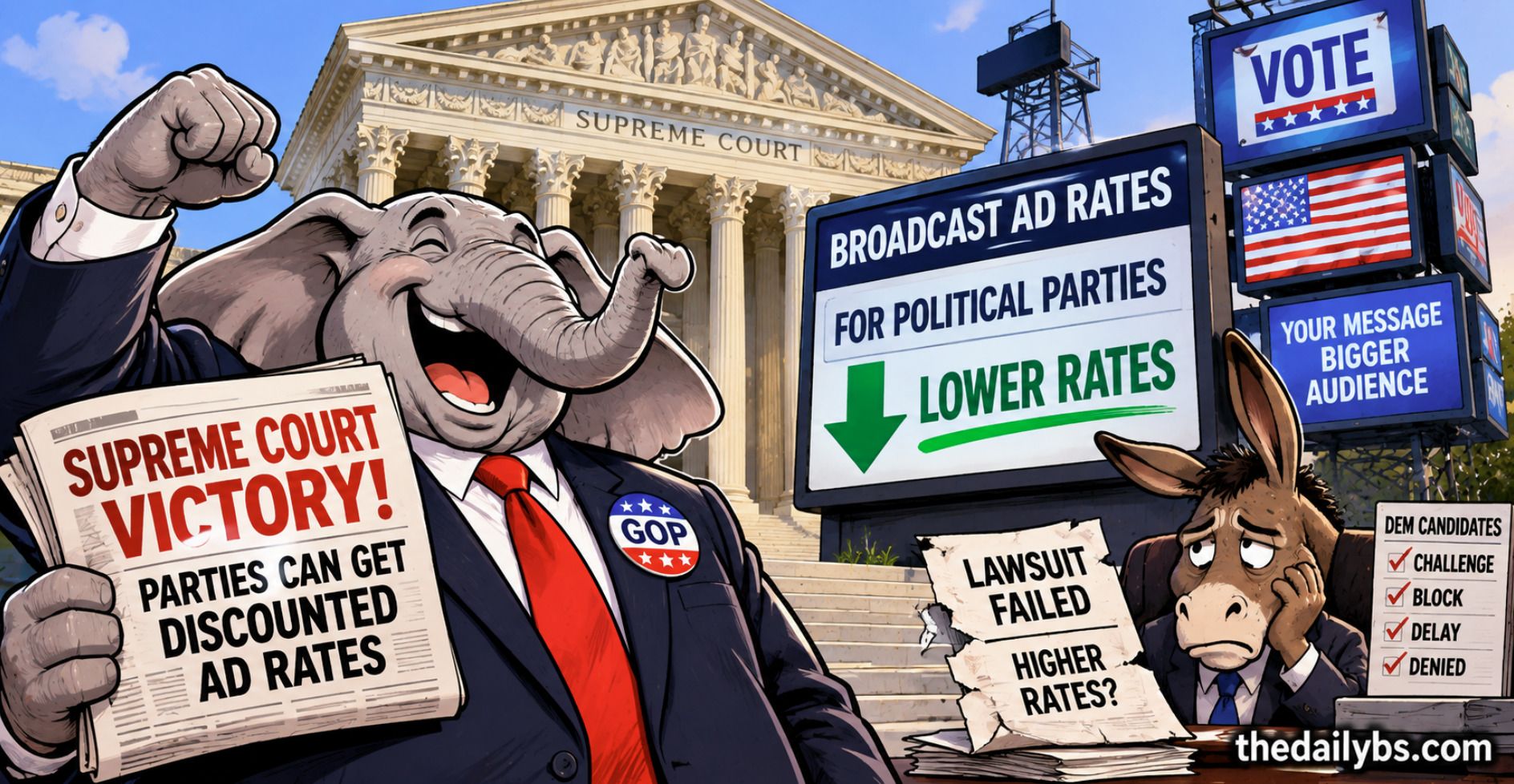
- The Supreme Court handed Republican campaign committees an important election-season victory Friday, temporarily restoring FCC guidance allowing political parties coordinating with candidates to receive discounted broadcast advertising rates.
- The ruling blocks a Fourth Circuit decision won by four Democratic candidates who argued federal law reserves those bargain rates for candidates themselves.
- The timing matters: The discounted general-election advertising period began Friday, and Republican committees told the Court they already had tens of millions of dollars in advertising planned around the lower rates.
Republicans just received some very good news from the Supreme Court. And television stations may be receiving considerably more Republican advertising.
The Supreme Court stepped into a fight over political advertising rates Friday and temporarily restored Federal Communications Commission guidance allowing political parties spending in coordination with candidates to take advantage of the same favorable broadcast rates available to candidates.
The ruling is an immediate victory for the National Republican Congressional Committee and National Republican Senatorial Committee just weeks before the November midterm elections.
But there’s an important distinction. The Supreme Court has not yet issued a final ruling that federal law guarantees political parties those rates. Instead, the justices halted a lower-court ruling that had struck down the FCC policy while Republicans pursue a fuller appeal.
Federal law requires broadcasters to offer legally qualified candidates what is known as the “lowest unit charge” during specified periods immediately preceding elections. For the November midterms, that 60-day general-election window began Friday — the same day the Supreme Court acted. The FCC’s Media Bureau issued guidance in March saying political parties engaging in coordinated activity with candidates, as well as certain joint fundraising committees, could also qualify for those rates.
Four Democratic candidates challenged the policy: Georgia Sen. Jon Ossoff, former Ohio Sen. Sherrod Brown, former North Carolina Gov. Roy Cooper and Michigan Rep. Kristen McDonald Rivet. They argued that the law specifically provides the discount to candidates and doesn’t extend it to political parties or joint fundraising committees.
A divided Fourth Circuit panel agreed with them Aug. 25 and threw out the FCC guidance.
Republicans then went to the Supreme Court. They told the justices the ruling was already blowing holes in their advertising budgets because broadcasters had begun rescinding discounted rates on previously planned purchases. The NRCC and NRSC said they had budgeted tens of millions of dollars in television advertising based upon receiving those rates.
The Supreme Court agreed that letting the Fourth Circuit decision remain in effect could cause irreparable harm. “Current and future rescissions will require the party committees to pay more for advertising space, thereby hampering their efforts to reach the electorate in the critical weeks leading up to the midterms,” the Court wrote.
There was another issue the justices found important. The Democratic candidates had initially asked the full FCC to review its Media Bureau’s guidance. But before the Commission completed that review, they went to the Fourth Circuit. The Supreme Court concluded there was a strong argument that the appeals court shouldn’t have stepped in before that administrative process was completed.
Justice Ketanji Brown Jackson disagreed and was the only justice to publicly note a dissent. She argued that Republicans were unlikely to prevail on their claim that the Fourth Circuit lacked jurisdiction.
For now, however, the Fourth Circuit ruling is frozen. That means the FCC guidance is effectively back in play while the case continues.
And there is a considerable political consequence. Republican national committees enter the final stretch of the midterms with substantially more cash than their Democratic counterparts.
The Washington Post reported that at the end of July, the Republican National Committee had more than $130 million in the bank. The Democratic National Committee had about $16 million — while carrying $18 million in debt.
The GOP’s House and Senate campaign committees also held financial advantages. Cheaper airtime means those Republican dollars can purchase even more airtime.
Democrats argue the FCC’s interpretation improperly expands a discount Congress intended for candidates and could allow wealthy outside interests to obtain cheaper advertising through joint fundraising arrangements. The Trump administration counters that the FCC guidance applies equally to everyone.
Solicitor General D. John Sauer told the Court that the policy “does not grant favored treatment to one side or the other.”
Legally, this fight isn’t over.
Politically, however, the clock is already running. There are fewer than two months until Election Day. And Republicans just got their cheaper television rates back.
DBS WIRE SOURCES:
- The Hill — Supreme Court sides with GOP in fight over TV ad rates; Jackson dissents
- Supreme Court — National Republican Congressional Committee v. Brown, Sept. 4 order
- Associated Press — Supreme Court grants Republican emergency appeal on TV ad rates before midterms
- CBS News — Supreme Court sides with Republicans in fight over broadcast ad rates
- Washington Post — In boost to GOP, Supreme Court says parties should get lower TV ad rates