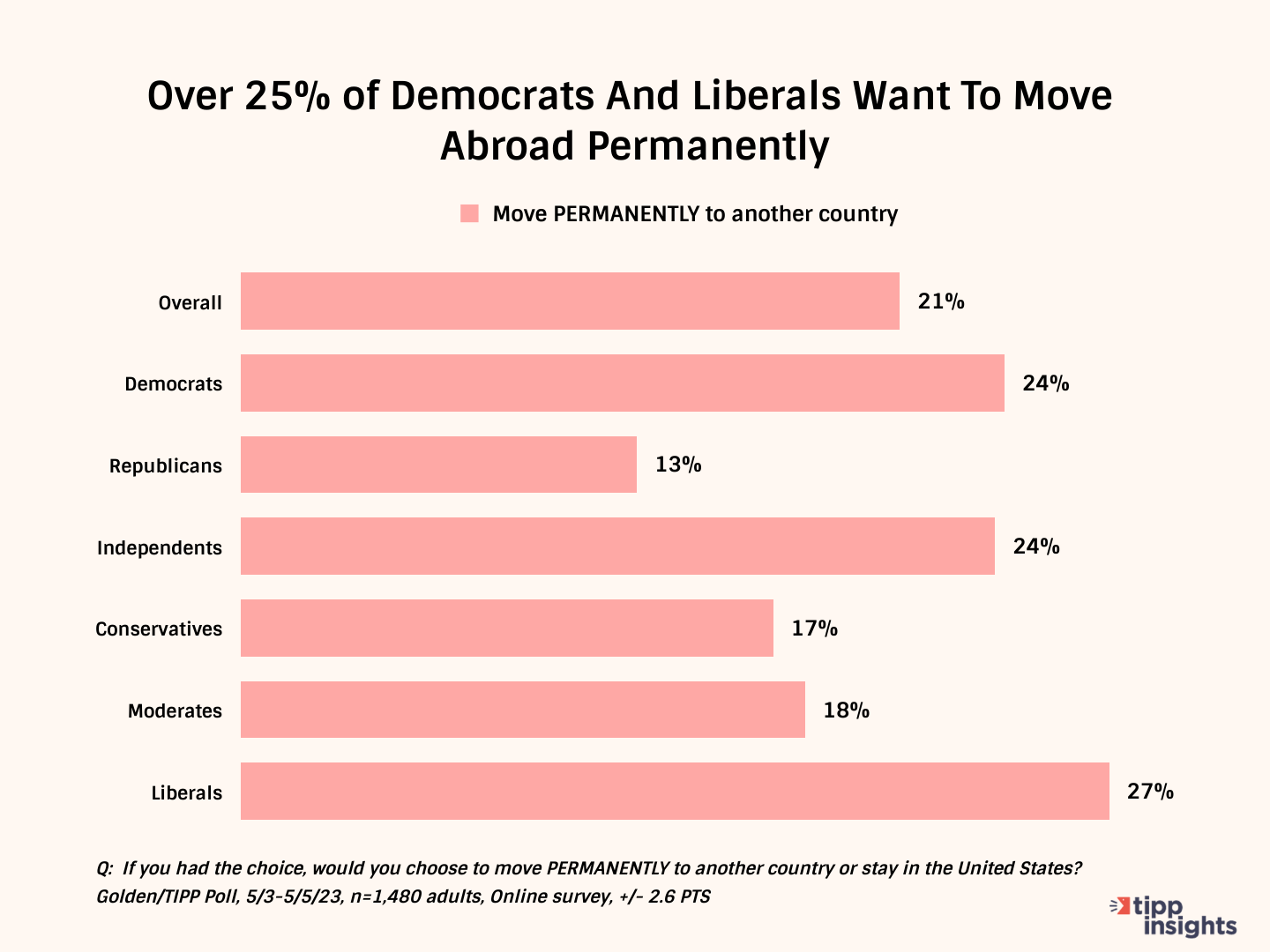
Over one in five Americans express a strong desire to permanently move to another country if given the opportunity, according to a recent Golden/TIPP Poll of 1,480 Americans nationwide.
Financial considerations significantly drive this desire.
Young adults exhibit the strongest yearning. Interestingly, Democrats and liberals are more inclined to leave, while Republicans and conservatives hold a contrasting sentiment.
The online survey was conducted from May 3 to 5. The survey’s credibility interval (CI) is +/- 2.8 percentage points, meaning the study is accurate to within ± 2.8 percentage points, 19 times out of 20, had all Americans been surveyed.
The survey asked respondents: “If you had the choice, would you choose to move permanently to another country or stay in the United States?” The results read as follows:
- 21% move permanently to another country
- 66% stay in the United States
- 13% not sure

Who Wants To Quit?
The desire to leave the United States varies among political parties and ideologies.
Surprisingly, Democrats (24%) and liberals (27%) express a desire to leave Biden’s America, while only 13% of Republicans and 17% of conservatives share the same sentiment.
Among the 36 demographic groups we analyzed, the 18-24 age group exhibits the highest desire to leave, with a staggering 36% expressing their willingness to do so if given the choice. Additionally, if given the opportunity, over a quarter (28%) of individuals in the 25-44 age group express their intention to quit.
It is worth noting that as age increases, the desire to leave diminishes, with only 8% of individuals in the age 65+ group expressing the wish.

What Is Driving The Desire?
In simple terms, financial considerations are the main driving force.
When comparing the two groups – those who want to leave and those who want to stay – across eight financial concerns, we consistently observe a significantly higher number of individuals wishing to quit expressing financial worries than those who want to remain.
Here are the differences across various financial aspects:
- Maintaining your current standard of living: 81% of those wanting to move abroad express concerns, compared to 67% of those wanting to stay in the U.S.
- Having enough savings for retirement: 78% of those wanting to move abroad have worries, while 64% of those wanting to stay in the U.S. share the same concern.
- Being able to pay medical or health care costs: 71% of those wanting to move abroad express this concern, in contrast to 58% of those wanting to stay in the U.S.
- Ability to pay utility bills: 66% of those wanting to move abroad worry about this, while 56% of those wanting to stay in the U.S. have similar concerns.
- Affording mortgage payments or rent: 64% of those wanting to move abroad express concerns, whereas 49% of those wanting to stay in the U.S. share this worry.
- Making on-time credit card payments: 56% of those wanting to move abroad express this concern, compared to 45% of those wanting to stay in the U.S.
- Making on-time auto loan/lease payments: 50% of those wanting to move abroad worry about this, while 36% of those wanting to stay in the U.S. have similar concerns.
- Financing children’s education: 43% of those wanting to move abroad express concerns, in contrast to 33% of those wanting to stay in the U.S.

Inflation has had a greater impact on individuals who wish to move abroad than those who want to stay in the United States.
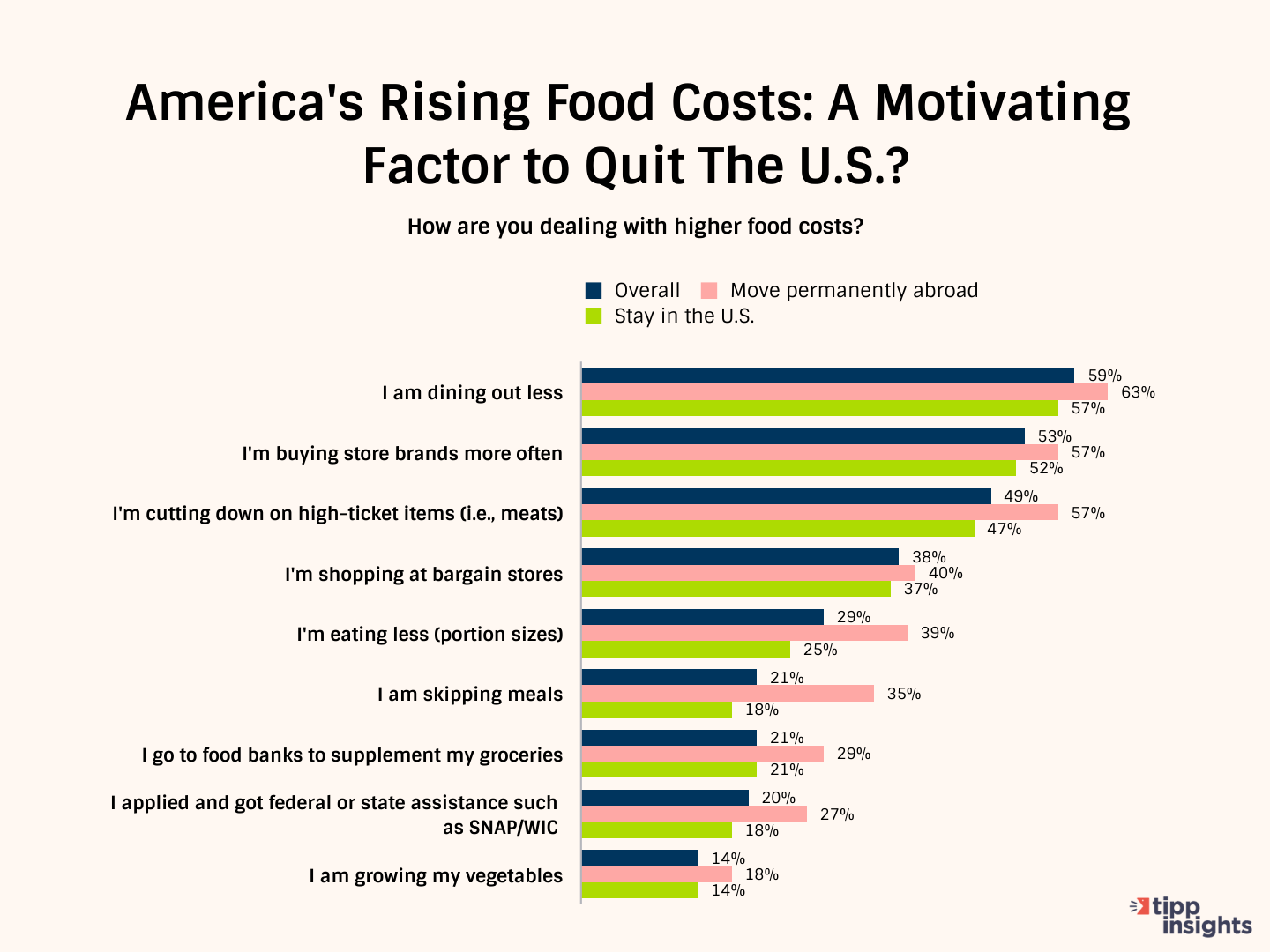
As Americans grapple with higher food costs, they employ different financial management strategies.
Echoing their financial concerns, a consistent pattern emerges, with a higher proportion of individuals wishing to leave opting for these strategies than those who want to stay.
For example, 35% of those wanting to leave are skipping meals, while only 18% of those who want to stay follow the same approach. Similarly, 39% of individuals intending to leave eat less, in contrast to 25% of those who wish to stay. Moreover, 27% of those seeking to depart have applied and received federal assistance such as SNAP/WIC, compared to 18% of those who desire to remain.
Job Sensitivity
We classify a household as job sensitive when at least one family member actively seeks full-time employment (job seekers) or if the family has concerns about potential layoffs within the next year (concerned).
Among American households, 54% exhibit job sensitivity. However, for those who want to move permanently abroad, this percentage increases to 70%. In contrast, the figure stands at only 50% for those who want to stay.
Similarly, 40% of U.S. households have a member actively seeking a full-time job. However, among those who want to move permanently abroad, this percentage increases to 55%, whereas it is only 36% for those who wish to stay.
Additionally, 35% of U.S. households express concerns about a member potentially losing their job within the next 12 months. However, among those desiring to move abroad permanently, this percentage increases to 51%, while it remains at only 32% for those who want to stay in the U.S.

Financial Stress
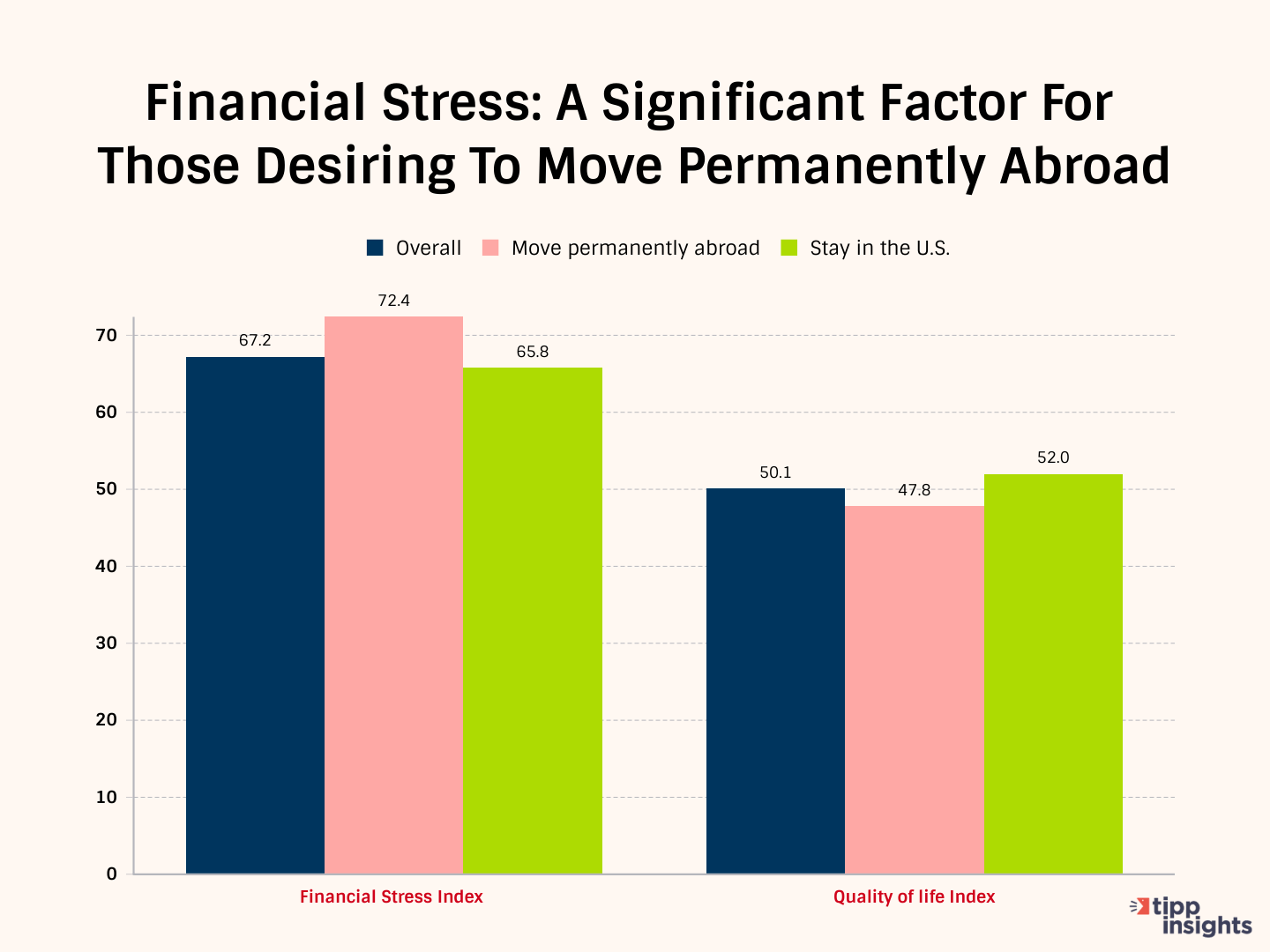
Our IBD/TIPP Financial Stress Index effectively captures the extent of financial struggles. This index measures financial stress on a scale from 0 to 100, with higher numbers indicating greater stress levels.
For individuals desiring to move permanently abroad, the Financial Stress Index stands at 72.4, which surpasses the overall index of 67.2. In comparison, those who wish to stay in the U.S. have a slightly lower index of 65.8.
Our Quality of Life Index is derived from the question, “In the next six months, do you anticipate that your quality of life will improve, worsen, or remain the same as it is now?” A higher index score reflects greater optimism regarding the quality of life.
Among individuals aspiring to relocate permanently abroad, the Quality of Life Index is 47.8, slightly lower than the overall index of 50.1. In contrast, those who wish to stay in the U.S. exhibit a slightly higher index of 52.0.
Conclusion
Over one in five Americans express a strong desire to permanently move to another country if given the opportunity, driven significantly by financial considerations. Young adults exhibit the highest yearning, while Democrats and liberals are more inclined to leave compared to Republicans and conservatives. This trend reflects disillusionment among young people, which is concerning considering they are the country’s future.
Like our insights? Show your support by becoming a paid subscriber!
TIPP Takes
Geopolitics And Geoeconomics
1. Ukraine Says ‘Biggest Blow’ Yet To Come In Counteroffensive Push – Al Jazeera
Ukraine’s Deputy Defense Minister Hanna Maliar said Kyiv’s forces and Moscow’s troops are engaged in a ‘tough duel,’ and Russia is throwing everything into the battle.

The Ukrainian military, which has maintained a strict silence about the counteroffensive campaign in general, announced that small victories had been achieved and eight villages liberated so far, along with some 70 sq miles of territory.
2. “Putin Threat Of Using Tactical Nuclear Weapons Real,” Says Joe Biden – NDTV
U.S. President Joe Biden said the threat of Russian President Vladimir Putin using tactical nuclear weapons is “real,” days after denouncing Russia’s deployment of such weapons in Belarus.

The United States has said it has no intention of altering its stance on strategic nuclear weapons in response to the deployment. It has not seen any signs that Russia is preparing to use a nuclear weapon.
3. Macron Announces Franco-Italian Made Missile System Delivered To Ukraine – RFI
“It really is Europe protecting Europe,” he added, referring to his opposition to a German proposal to develop an anti-missile defense system for Ukraine by purchasing U.S. and Israel equipment.

Ukraine received two American-made Patriot air defense systems at the end of April. For the French presidency, announcing the deployment of the SAMP/T Mamba shows that there is an alternative.
4. Xi, Blinken Agree To Stabilize U.S.-China Ties In Beijing Talks – Al Jazeera
China and the U.S. have agreed to try and avoid veering into conflict but did not announce any major breakthroughs during a visit by Secretary of State Antony Blinken to Beijing.

A roughly 30-minute meeting with Xi on Monday was Blinken’s final engagement on the closely watched trip.
There are hopes that the two-day talks could lead to a meeting between U.S. President Joe Biden and Xi this year.
5. U.S.-China Relations On The “Right Trail,” Says Biden – Reuters
President Joe Biden said he thinks relations between the U.S. and China are on the “right trail,” but he did not think progress was made during a rare trip to Beijing by Secretary of State Antony Blinken.

When asked whether he felt progress had been made, he replied, “I don’t feel, you know, it’s been made.”
Biden, however, praised Blinken and said, “he did a hell of a job.”
6. China’s Economic Slowdown Makes Taiwan Crisis More Likely: Report – Nikkei Asia
An increasingly sluggish Chinese economy could increase the prospect of a military crisis in the Taiwan Strait as Chinese President Xi Jinping may further embrace nationalism in his unprecedented third term, a U.S. think tank warned.

In the report by a bipartisan task force convened by the Council on Foreign Relations covering U.S.-Taiwan relations, experts warned that Washington’s four-decade-old framework for dealing with Taiwan since establishing diplomatic relations with China in 1979 had become “more and more brittle.”
7. UN Rights Chief Seeks To Establish Presence In China And India – Reuters
UN human rights chief, Volker Turk, called for greater support for his office as he seeks to expand its work by establishing a first-time presence in the world’s two most populous countries, India and China, whose rights records are drawing more scrutiny.

There was no immediate response from China or India’s diplomatic mission in Geneva. Setting up in China might prove difficult for Turk’s office.
8. Chinese Tech Giant Alibaba Names Next CEO – AFP
Chinese tech giant Alibaba announced it would replace chairman and CEO Daniel Zhang with current executive vice chairman Joseph Tsai in September.

The firm has faced several unprecedented headwinds in recent years as Beijing imposed tighter restrictions on the domestic tech sector. In late March, Alibaba said it would split into six business groups in one of the most significant overhauls of a leading Chinese tech firm.
9. UN Chief Tells Israel To Halt ‘Illegal Settlements’ In Palestine – Al Jazeera
United Nations Secretary-General Antonio Guterres has called Israel to “cease all settlement activities” in occupied Palestinian territory immediately.

He described Israel’s plans to advance the building of Israeli settlements as driving “tensions and violence” and being a major obstacle to lasting peace.
10. Intel Announces $33b Agreement To Build Two Semiconductor Plants In Germany – UPI
The “Silicon Junction” project is expected to create 3,000 permanent high-tech jobs at Intel and will be the first in Europe.

Last week the company announced a $4.6 billion investment in a new semiconductor assembly and test facility near Wrocław, Poland. Along with that project and an existing wafer fabrication facility in Ireland, Silicon Junction will create an end-to-end semiconductor manufacturing chain in Europe.
11. ‘Israel’s Oldest Friend In Tech’: Intel To Invest $25bn In New Plant – Middle East Eye
U.S. semiconductor giant Intel will spend $25bn on a new chip manufacturing plant in Israel. Prime Minister Benjamin Netanyahu calls it the country’s single largest foreign investment.

The “agreement in principle” would see the semiconductor firm build the facility in Kiryat Gat, which would open by 2027 and operate at least until 2035, Israel’s finance ministry said.
12. Canada Announces New Sanctions Against Iran – UPI
Canada announced a new package of sanctions against Iran, the 12th round of sanctions against the regime since October.

Seven Iranian court system members were sanctioned for their role in human rights violations under the country’s criminal justice system. Six are members of the Revolutionary Court.
13. UN Calls For ‘Gender Apartheid’ To Be Criminalized – RFI
Richard Bennett, the UN’s top expert on human rights in Afghanistan, has urged countries to consider making “gender apartheid” an international crime to hold the Taliban accountable for grave and systematic abuses against Afghan women.

Presenting his latest report, the UN special rapporteur on the situation in Afghanistan told the UN Human Rights Council that the Taliban’s actions could constitute the crime against humanity of “gender persecution.”
14. UN Adopts World’s First Treaty On High Seas, Antonio Guterres Lauds Member States – WION
After 15 years of negotiations, the United Nations (UN) has finally adopted the world’s first legally binding treaty to protect the high seas and preserve marine biodiversity in international waters.

The Biodiversity Beyond National Jurisdiction Treaty (BBNJ), more widely known as the High Seas Treaty, calls for imposing rules to protect the environment and resolve disputes over natural resources, shipping, and other matters in waters beyond any country’s national jurisdiction.
15. Europe Is World’s Fastest-Heating Continent, Report Warns – RFI
A joint report by the UN’s World Meteorological Organization and EU scientists said Europe was the fastest-warming continent on the planet. The temperature has risen by about twice the global average since the 1980s.

Scientists have warned of record high temperatures worldwide as excess warming from climate change mixes with a tip toward El Nino.
Please email [email protected]
Republished with permission from TIPP Insights