

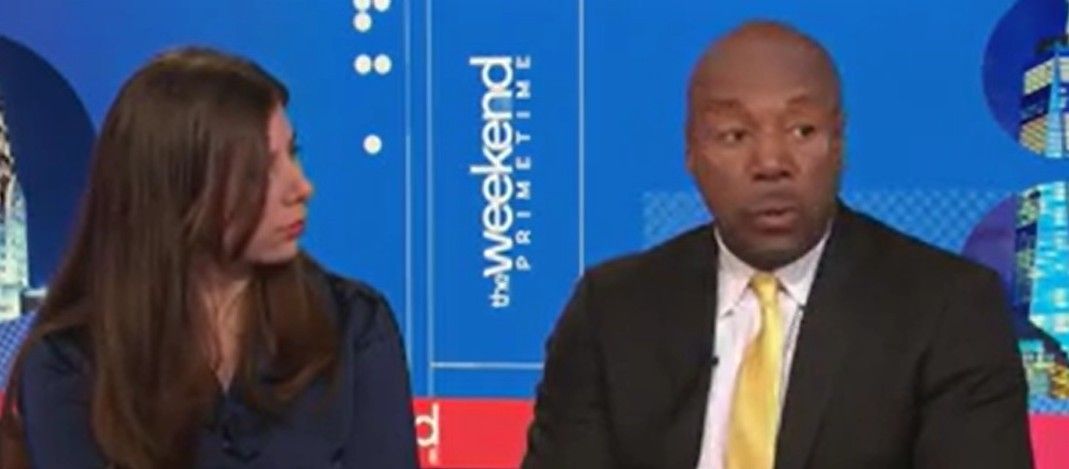
MS NOW’s resident legal firebrand Paul Butler lit his hair on fire—figuratively speaking—over the Supreme Court’s latest 6–3 decision striking down Louisiana’s race-based congressional map. His verdict? Not just bad. Not just controversial. According to Butler, it ranks among the worst race-related rulings in American history.
Appearing on The Weekend: Primetime, Butler didn’t just criticize the decision—he detonated a rhetorical bomb. “In some ways, this is one of the worst Supreme Court decisions on race ever,” he declared. “It’s actually worse than Plessy versus Ferguson. Plessy actually required formal equality, separate but equal. With this case, Black and Brown votes don’t have the same power as White votes.”
That comparison—placing a modern election law dispute above the infamous 1896 ruling that enshrined segregation—left even his MS NOW host momentarily speechless. Co-host Ayman Mohyeldin could only muster a stunned “wow.”
Doubling down, he reached even further back into the nation’s darkest legal chapters. “It’s like the Dred Scott decision, where the court said that the Black man has no rights that the white man is bound to respect,” he said. “The Supreme Court is saying that the Black voter and the Brown voter has no rights that it respects.”
For context, the Court’s conservative majority ruled that Louisiana’s second majority-Black district was drawn predominantly based on race, crossing a constitutional line. Chief Justice John Roberts reportedly described the oddly shaped district as a “snake,” while Justice Samuel Alito flatly called it an “unconstitutional gerrymander.”
Alito spelled out the broader principle: “Allowing race to play any part in government decision making represents a departure from the constitutional rule that applies in almost every other context.” He also argued that the Voting Rights Act—once aimed at stopping explicit discrimination—has been stretched beyond recognition by mapmakers chasing political advantage. Section 2, he emphasized, applies only in cases of intentional discrimination, which carries a “very high standard” of proof.
Back on MS NOW, though, that nuance was nowhere to be found. Instead, the panel veered into familiar territory—panic and hypotheticals. Co-host Catherine Rampell openly wondered if Democrats’ next move should be “packing the court,” a once-fringe idea that now pops up whenever rulings don’t go their way.
Meanwhile, over at CNN, Abby Phillip warned the decision could “eradicate” minority representation across the South—another dire prediction in a long line of worst-case scenarios.
And then there’s Donald Trump, who had a much simpler reaction. “That’s good!” he said with visible enthusiasm when told about the ruling. “That’s the kind of ruling I like.” Just a thumbs-up.








These black commentators love to make a point that the SCOTUS is doing something to the black and brown Americans when they decide a case. Not true, let’s be very honest, the SCOTUS must be colored blind when it comes to the constitution given us by our founders. The fact that this particular decision is in direct conflict of how the left is using the black and brown situation status to thwart the blindness of the SCOTUS’s decision. We as Americans have been lied to regarding the facts that Democrats have used race to divide our nation is terrible. Since President Obama became President, the first black man to be in the White House, it seems our black brothers and sisters have become more radicalized creating a black, white confrontation.