- Fully 61 percent of respondents support a cartel-busting US military campaign
- Nearly 110,000 people in US died from drug overdoses last year, mostly fentanyl
- Mexico’s cartels make billions of dollars from trafficking the powerful opioid
- Where do the cartels get 80 percent of their weapons? Find out in this article
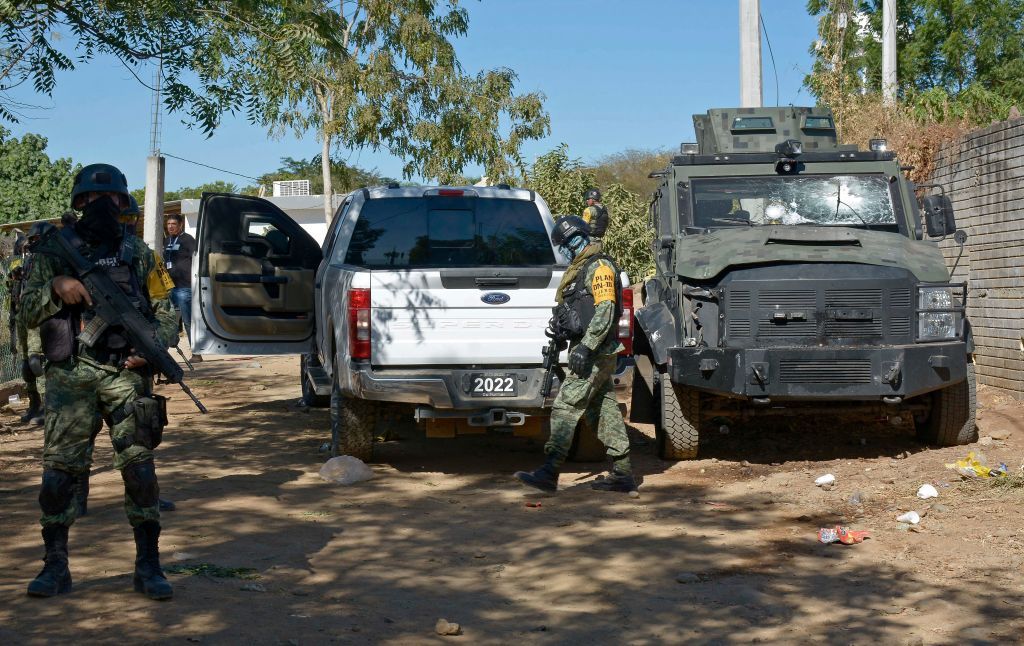
Voters by wide margins support deploying the military across the border to stop Mexican drug cartels producing deadly drugs and smuggling them into the US, a DailyMail.com/TIPP poll shows.
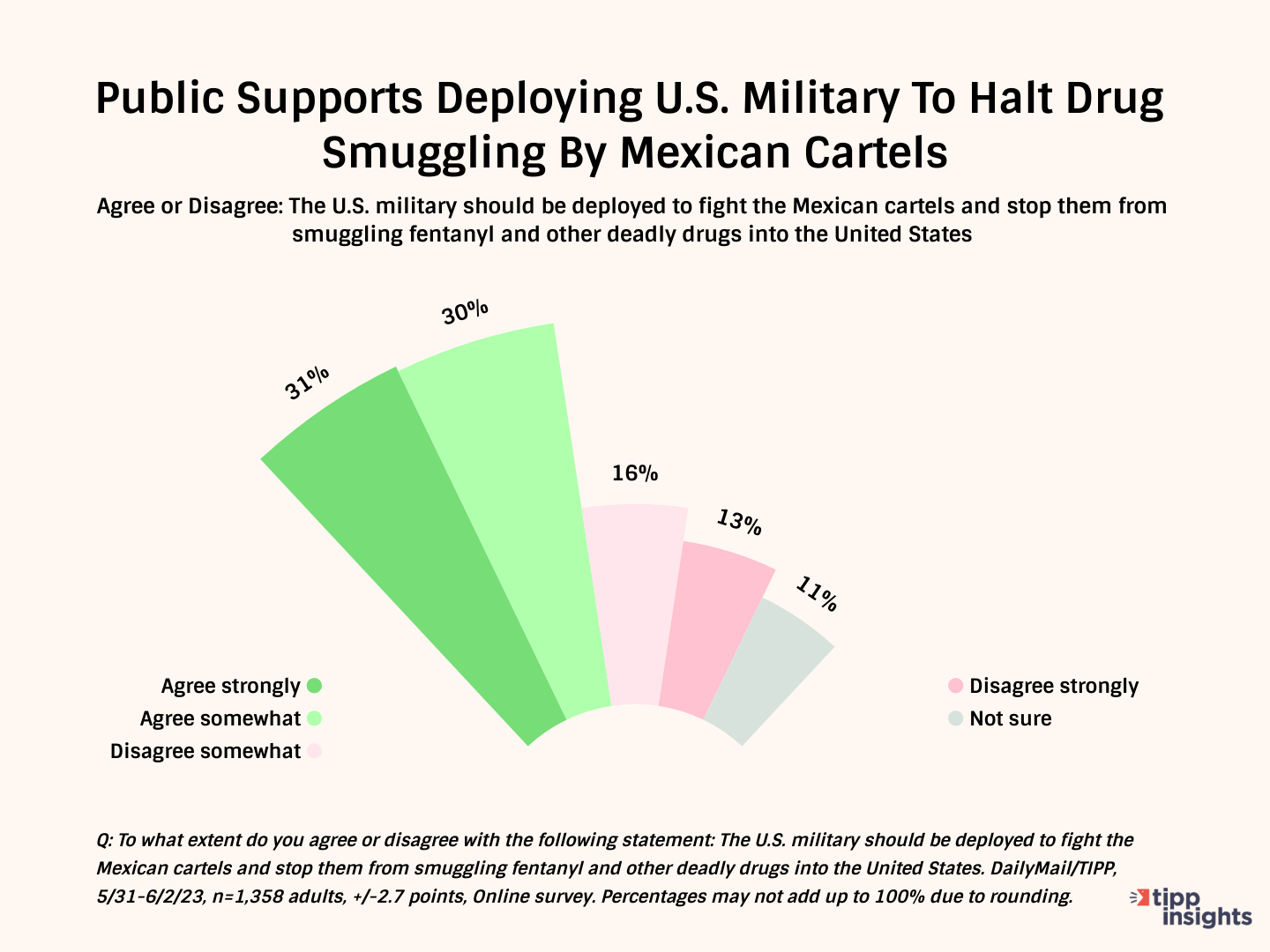
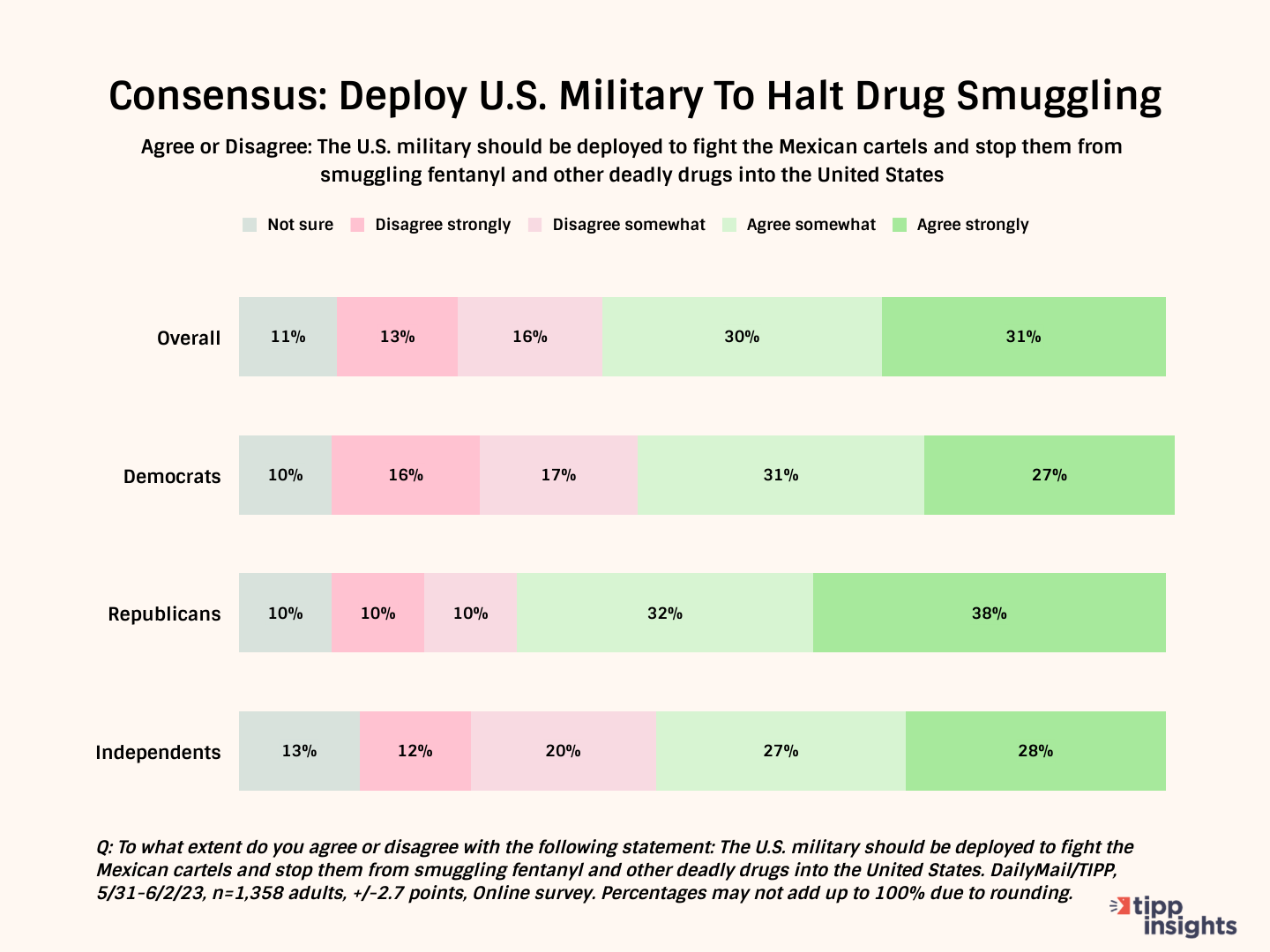
Fully 61 percent of respondents support using US forces to tackle cartel paramilitaries head-on — a policy that’s been championed by Republican presidential wannabes Tim Scott and Donald Trump.
The results signal growing frustration about lax security at the southern border and drug flows into the US, where nearly 110,000 people died from drug overdoses last year, according to federal data.
Trump, Scott, and other Republicans have called for deploying the US military to attack drug labs in Mexico, where the powerful opioid fentanyl is produced using precursor chemicals imported from China.
Plans also involve designating the Sinaloa, Jalisco New Generation, and other cartels as terrorist organizations and slapping them with sanctions so that leaders cannot move money or travel internationally.
Former president Trump said last week he would deploy military assets to fight the fentanyl crisis and ‘inflict maximum damage’ on cartel operations if elected in 2024.
He would also seek the death penalty to convicted drug dealers and human traffickers, he said.
‘Under my leadership, we took the drug and fentanyl crisis head on, and we achieved the first reduction in overdose deaths in more than 30 years,’ Trump said in a campaign video.
‘Sadly, under Joe Biden, our hard-won progress has been surrendered, along with the surrender of our southern border.’
Trump, the front-runner in the Republican presidential nomination race, said ‘fentanyl and other ultra-deadly poisons are pouring into our country unchecked — stealing more than 100,000 American lives every single year.’
The DailyMail.com/TIPP survey of nearly 1,400 adults suggests the policy resonates with voters.
Some 31 percent of respondents said they ‘strongly’ backed the use of military force, while another 30 percent said they ‘somewhat’ felt the same way.
Another 29 percent were against using the military, and 11 percent were not sure.
Fully 70 percent of Republicans wanted to see cartel drug labs attacked, while 58 percent of Democrats agreed.
Synthetic opioids — mostly fentanyl — now kill more Americans every year than died in the Vietnam, Iraq, and Afghanistan wars combined.
This feeds an argument among some politicians that the cartels should be branded terrorist groups and prompting once-unthinkable calls for US military intervention across the border.
It remains unclear exactly what military operations have been considered, whether they would halt or deter the cartels, and whether they would result in geopolitical blowback.
Mexico’s president Andrés Manuel López Obrador in March said that his country does not produce or consume fentanyl, despite enormous evidence to the contrary, and framed the synthetic opioid epidemic largely as an American social problem.
The groundwork for the US fentanyl epidemic was laid more than 20 years ago, with aggressive over-prescribing of the synthetic opioid oxycodone.
As US authorities clamped down on its prescription, users moved to heroin, which the Sinaloa cartel happily supplied.
But making its own fentanyl — far more potent and versatile than heroin — in small, easily concealed labs was a game changer.
The cartel went from its first makeshift fentanyl lab to a network of labs concentrated in the northern state of Sinaloa in less than a decade.
A single cartel ‘cook’ can press fentanyl into 100,000 counterfeit pills every day to fool Americans into thinking they’re taking Xanax, Percocet or oxycodone.
The pills are smuggled over the border to supply drug addicts across the US, including the homeless users seen stumbling around on the streets of San Francisco, New York and other big cities.
Fentanyl is so cheap to make that the cartel reaps massive profits even wholesaling the drug at 50 cents per pill, investigators say.
The drug’s potency makes it particularly dangerous.
The narcotic dose of fentanyl is so close to the lethal dose that a pill meant to ensure a high for a habituated user can easily kill a less experienced person taking something they didn’t know was fentanyl.
Agencies contributed to this report.
Original article link
Like our insights? Show your support by becoming a paid subscriber!
TIPP Takes
Geopolitics And Geoeconomics
1. Kremlin Says Goal To ‘Demilitarize’ Ukraine Has Largely Been Achieved – Al Arabiya
The Kremlin claimed that Russia’s goal to “demilitarize” Ukraine has mostly been achieved as Kyiv uses fewer and fewer of its own weapons, spokesman Dmitry Peskov said in an interview.

Peskov said Russia’s military has largely knocked out Ukraine’s domestically produced weapon systems, forcing the country to rely on Western arms.
2. War-Hit Ukraine Seeks $40 Billion In Initial Phase To Rebuild Economy – Reuters
War-torn Ukraine is seeking up to $40 billion to fund the first part of a “Green Marshall Plan” to rebuild its economy, a senior Ukrainian government official said.

The World Bank estimates Ukraine’s reconstruction will cost $411 billion, three times the country’s gross domestic product. Since Russia’s invasion, external backers have poured $59 billion into Ukraine for financing needs.
3. Ukrainian Saboteurs May Have Destroyed Ammonia Pipeline: Reports – WION
The report, citing experts from the German defense ministry, claims that Ukrainians are sabotaging far beyond the line of contact in order to weaken the Russian forces.

The report notes “participation of the Ukrainian side in the destruction of the pipeline [Togliatti-Odessa]” cannot be ruled out.
The revelation by the publication matches the version of the Russian authorities who had blamed Ukrainian forces for the destruction job.
4. Russia Says Regional Free Trade Pact With Iran Possible By Year-End – Reuters
A free trade zone agreement between Iran, Russia, and several Eurasian countries that cover the region spreading from the borders of Eastern Europe to Western China is possible by the end of the year.

Russian Deputy Prime Minister Alexei Overchuk said in an interview that talks between the Eurasian Economic Union – which comprises Armenia, Belarus, Kazakhstan, Kyrgyzstan, and Russia – and Iran are in their final stages.
5. Putin Does Not Rule Out That Ukraine’s Army Commander-In-Chief Could Be Abroad – Al Arabiya
When asked about Valeriy Zaluzhny’s whereabouts, Putin told reporters: “I know. I think I know. I think he is abroad. But I could be wrong.”

Russian state media claimed in May that Zaluzhny suffered a head injury and several shrapnel wounds due to a Russian missile strike that targeted a command post near the city of Kherson.
6. We Must Choose Between “Cooperation Or Conflict”: China Tells U.S. – AFP
China and the U.S. must choose between “cooperation or conflict”, China’s highest-ranking foreign policy official, Wang Yi, told U.S. Secretary of State Antony Blinken.

“We must reverse the downward spiral of China-U.S. relations, push for a return to a healthy and stable track, and work together to find a correct way for China and the United States to get along,” Wang added.
Wang Yi’s position in the Communist Party ranks above the foreign minister.
7. Taiwan ‘Most Prominent Risk’ In China-U.S. Ties, FM Says After ‘Candid’ Blinken Talks – Al Arabiya
China’s foreign minister, Qin Gang said that Taiwan represented the “most prominent risk” to relations with the U.S., after he met with U.S. Secretary of State Antony Blinken.

The ministry stated that the two diplomats’ discussion was long and described the talks as “candid, in-depth and constructive.”
8. Pirelli: Italy Blocks Chinese Control Of Tyre Giant – BBC
Italy has moved to block a Chinese state-owned company from taking control of tyre-making giant Pirelli. The decision is part of measures announced by Italy’s government to protect Pirelli’s independence.

Beijing-controlled chemical giant Sinochem is Pirelli’s biggest shareholder, with a 37% stake in the 151-year-old Milan-based firm.
It comes as tensions between Beijing and the West are in focus as the U.S. secretary of state visits China.
9. Paris Summit Seeks Pact To Repair Broken Global Financial System – RFI
French President Emmanuel Macron will host world leaders in Paris this week for a summit to overhaul a global financial system dating back 80 years so the world is better able to respond to climate change and future pandemics.

No formal decisions will be taken at Summit for a New Global Financial Pact, which is instead seeking to build momentum for reforming lending mechanisms so poorer nations can access urgent financing to address their most urgent needs.
10. ‘An Obstacle To Peace’: U.S. Lambasts Israeli Moves To Expand West Bank Settlements – The Times Of Israel
The U.S. State Department said that it was “deeply troubled” by Israeli moves to significantly advance settlement construction in the West Bank, which Washington branded as an “obstacle to peace.”

Earlier, Israel’s Finance Minister Bezalel Smotrich announced that the Defense Ministry body in charge of authorizing settlement construction had released its agenda for meetings next week where it will advance plans for 4,560 new settlement homes.
11. Netanyahu Says Israel Opposes Nuclear ‘Mini-Agreements’ With Iran – The Times Of Israel
“Our most important mission is to curb Iran’s nuclear program,” Israeli Prime Minister Benjamin Netanyahu said in the wake of reports of an impending understanding between the U.S. and Iran.

“We also tell [the U.S.] that even… ‘mini agreements,’ in our opinion, do not serve our goals, and we oppose those as well,” he added.
12. North Korea Cites Failed Satellite Launch As ‘Most Serious’ Failure – Yonhap
North Korea called its failed attempt to launch a purported military reconnaissance satellite the “most serious” shortcoming in the first half of this year and reaffirmed its pledge to put it into orbit soon.

The North made the assessment following a plenary meeting of the 8th Central Committee of the ruling Workers’ Party of Korea, attended by leader Kim Jong-un.
13. Officials In North Korea “Bitterly” Slammed For Failed Spy Satellite Launch: Report – AFP
In the meeting of the Central Committee of the Workers’ Party of Korea, the ruling party “bitterly criticized the officials who irresponsibly conducted the preparations for satellite launch” and demanded a probe into the “serious” failure.

14. Australia Sets Stage For Landmark Indigenous Rights Referendum – Al Jazeera
Australia’s parliament has passed legislation to pave the way for a historic referendum on Aboriginal rights, with voters set to decide if the Indigenous population gets a dedicated “voice” in national policymaking.

The referendum will ask Australians whether they support altering the constitution to include a “Voice to Parliament“, a committee that can advise the parliament on matters affecting Aboriginal and Torres Strait Island people in Australia.
15. Nearly One In 10 Jobs Could Be Replaced By AI Within Decade, Says OECD – RFI
To be published in July, the Organisation for Economic Co-operation and Development report warns that highly skilled workers are at risk of being replaced by AI.

“This time, the jobs that can be automated are higher intellectual jobs, in the tertiary sector, unlike previous industrial revolutions, which destroyed blue-collar jobs,” Stefano Scarpetta, director of research at the OECD, told France Télévisions.
Please email [email protected]
Republished with permission from TIPP Insights