

President Donald Trump’s proposed White House ballroom has run into a bouncer even he cannot easily fire, the United States Court of Appeals.
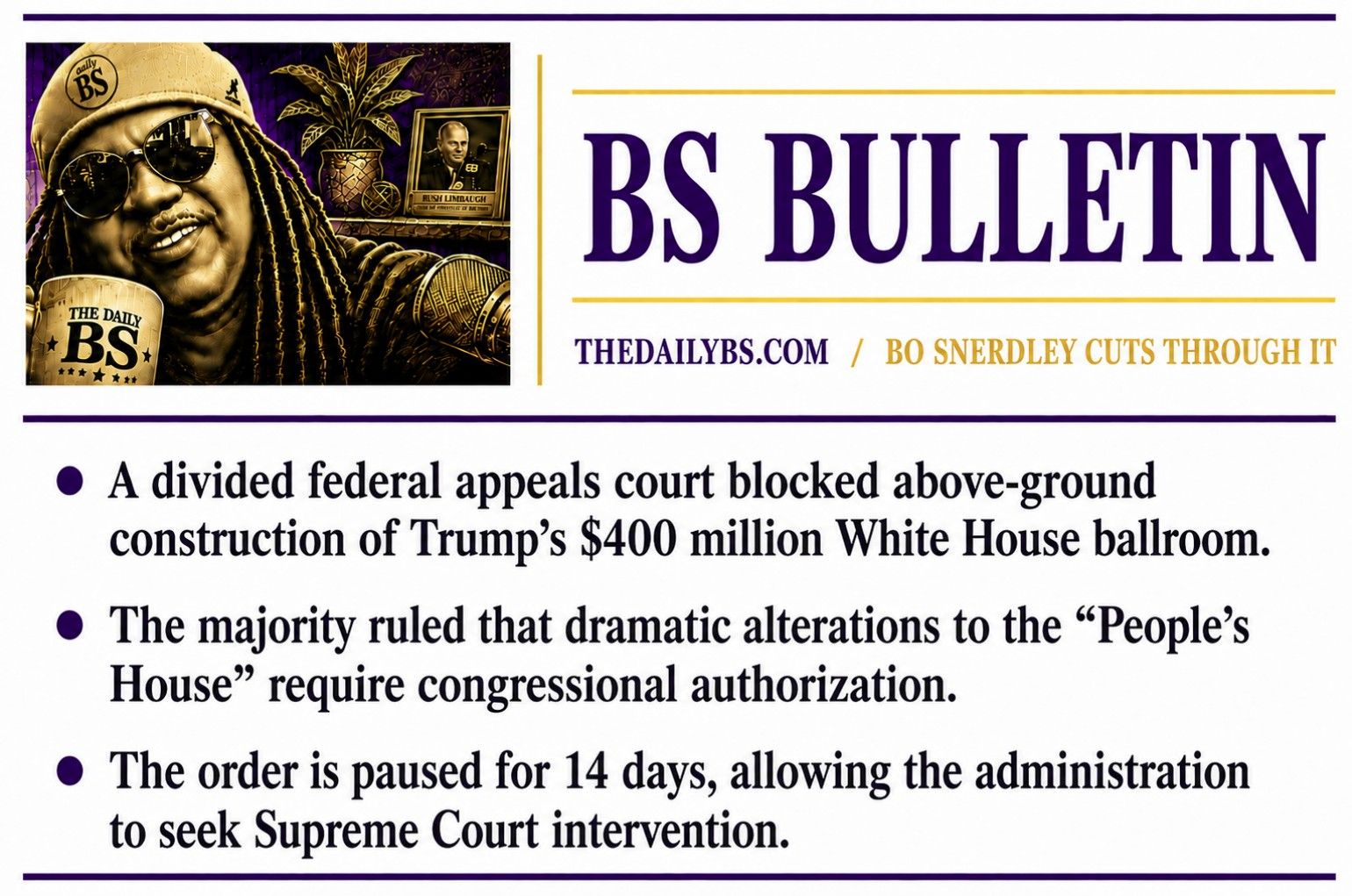
In a 2-1 ruling Friday, the U.S. Court of Appeals for the District of Columbia Circuit upheld a preliminary injunction blocking above-ground construction of Trump’s privately financed, $400 million ballroom unless Congress authorizes the project.
The ruling represents the administration’s biggest legal setback yet in its attempt to erect a 90,000-square-foot ceremonial complex where the historic East Wing once stood.
The court’s order will not immediately take effect. Judges paused it for 14 days, giving the Trump administration an opportunity to appeal to the Supreme Court. The White House and Justice Department had not issued an immediate response as of Friday afternoon, according to Reuters.
The majority’s bottom line was blunt, private money does not convert federal property into presidential property.
“Whether or not a massive ballroom should be constructed is for Congress to decide and is not a matter for Executive self-help,” the judges wrote.
The ruling was issued by Judges Patricia Millett, appointed by Barack Obama, and Bradley Garcia, appointed by Joe Biden. Judge Neomi Rao, a Trump appointee, dissented.
Trump has promoted the ballroom as a long-overdue addition capable of accommodating large state dinners, official ceremonies and other events that currently require temporary outdoor structures.
The administration has also argued that the broader East Wing project includes vital security improvements. Government lawyers described underground bunkers, medical facilities, bomb shelters, rooftop defenses and other protective features intended to harden the White House complex against attacks.
But the majority said the president’s security arguments did not furnish unlimited authority to redesign one of the country’s most historically significant public buildings.
In one of the opinion’s most striking passages, the judges explained why they believed Congress retains control:
The White House is the People’s House, and under the Constitution’s Property Clause, Congress exercises plenary control over the building and its surrounding land. The White House is also the centerpiece of President’s Park, a National Park stewarded by the National Park Service. According to the government, as the oldest public building in the District of Columbia, the White House is the crown jewel not just of President’s Park, but also of the Lafayette Square National Historic Landmark District, a site listed for preservation in the National Register of Historic Places. See Finding of No Significant Impact, White House East Wing Modernization & State Ballroom Environmental Assessment (“FONSI”), ECF No. 14-2, at 5. The founding architect of the Nation’s capital, Pierre L’Enfant, designed the capital city’s layout to focus on the towering Capitol building—the gleaming palace of the people in the new democracy—and to contrast it with the simple humility of the White House. See SCOTT W. BERG, GRAND AVENUES: THE STORY OF PIERRE CHARLES L’ENFANT 112 (2008) (“Where the king’s bedroom was placed on the central axis of Versailles, enshrining the rule of divine right transferred via primogeniture, here in L’Enfant’s plan the home of Congress took center stage.”); FONSI at 5 (“Situated on a high point within the city, the White House is a focal point on the principal north-south axis of L’Enfant’s plan.”).
That passage goes to the constitutional heart of the dispute. The president lives and works in the White House, but he does not own it. Congress controls federal property under the Constitution’s Property Clause, and the court found no statute granting the executive branch unilateral power to make a structural alteration of this magnitude.
The ruling does not permanently kill the ballroom. It preserves a construction freeze while the underlying lawsuit proceeds and says Trump must obtain congressional authorization if he wants above-ground work to continue in the meantime.
The majority emphasized that it was not passing judgment on the ballroom’s appearance, usefulness or political popularity:
This holding has nothing at all to do with whether the proposed ballroom is desirable, or not, as a matter of policy. This ruling does not even necessarily mean that the Defendants may not ultimately construct the ballroom. What it does mean is that the Defendants may not do so during the district court’s expeditious litigation without securing Congress’s authorization, as the Constitution and laws require. At this preliminary stage, the National Trust has shown, compellingly, that Congress has not ceded unfettered authority to the Executive Branch to dramatically redesign, reshape, and reconstruct the White House—the People’s House—to fit a particular President’s desires.
In plain English: The ballroom may eventually be built, but the president cannot simply wave a gold-plated executive wand and pronounce the permits handled.
The injunction applies to above-ground construction. Earlier rulings permitted work on certain underground security components to continue, including facilities the administration says are necessary to protect the president and White House personnel.
Trump initially promoted the project as a privately funded gift that would not burden taxpayers. Its projected cost has since doubled to roughly $400 million.
The president defended the increase in a Truth Social post, saying the new ballroom would be “approximately twice the size, and a far higher quality, than the original proposal.”
“It will be magnificent, safe, and secure!” Trump declared.
The project’s footprint has expanded along with its price. What began as a ballroom described as being near—but not interfering with—the East Wing ultimately resulted in the East Wing’s complete demolition.
That sequence became a central political vulnerability for the administration. Trump had previously assured the public that the ballroom would sit “near” the historic structure without touching it.
The National Trust for Historic Preservation sued in December, arguing that the administration unlawfully moved ahead without congressional authorization or adequate review.
Its complaint accused the government of failing to submit completed plans to the National Capital Planning Commission and the Commission of Fine Arts before demolition. The organization also alleged violations of the National Environmental Policy Act.
“No president is legally allowed to tear down portions of the White House without any review whatsoever—not President Trump, not President Joe Biden, and not anyone else,” the complaint said.
U.S. District Judge Richard Leon, an appointee of President George W. Bush, previously agreed that the challengers were likely to succeed. He twice blocked above-ground work while allowing underground security construction to proceed.
Leon concluded that no existing federal statute “comes close to giving the President” unilateral authority to build the ballroom without congressional approval.
The Justice Department appealed, contending that courts should not second-guess the privately financed project and warning that stopping work could interfere with national-security improvements.
During appellate arguments, Justice Department attorney Yaakov Roth characterized the preservationists’ objections as an “architectural preference” that should not outweigh White House security.
Thaddeus Heuer, an attorney representing the National Trust, offered a considerably simpler explanation of the administration’s position: “They just don’t want to go to Congress.”
Friday’s majority essentially agreed.
Judge Rao dissented from the majority’s decision, siding with the administration in the latest chapter of the litigation. Her vote nevertheless left the administration on the losing side of the three-judge panel.
Trump’s next destination is likely the Supreme Court. His lawyers can ask the justices to keep construction moving while the appeal continues, challenge the injunction directly or both.
Until then, the ballroom is legally stuck somewhere between a construction project and a very expensive architectural rendering.
DBS WIRE SOURCES:
- Reuters: U.S. appeals court blocks Trump’s $400 million White House ballroom project
- Associated Press: Appeals court rules Trump can’t build White House ballroom without congressional approval
- Courthouse News Service: D.C. Circuit weighs national-security claims in White House ballroom dispute
- National Trust for Historic Preservation: White House preservation and advocacy












get off trump’s back.
donations paying for it!