BS BULLETIN:
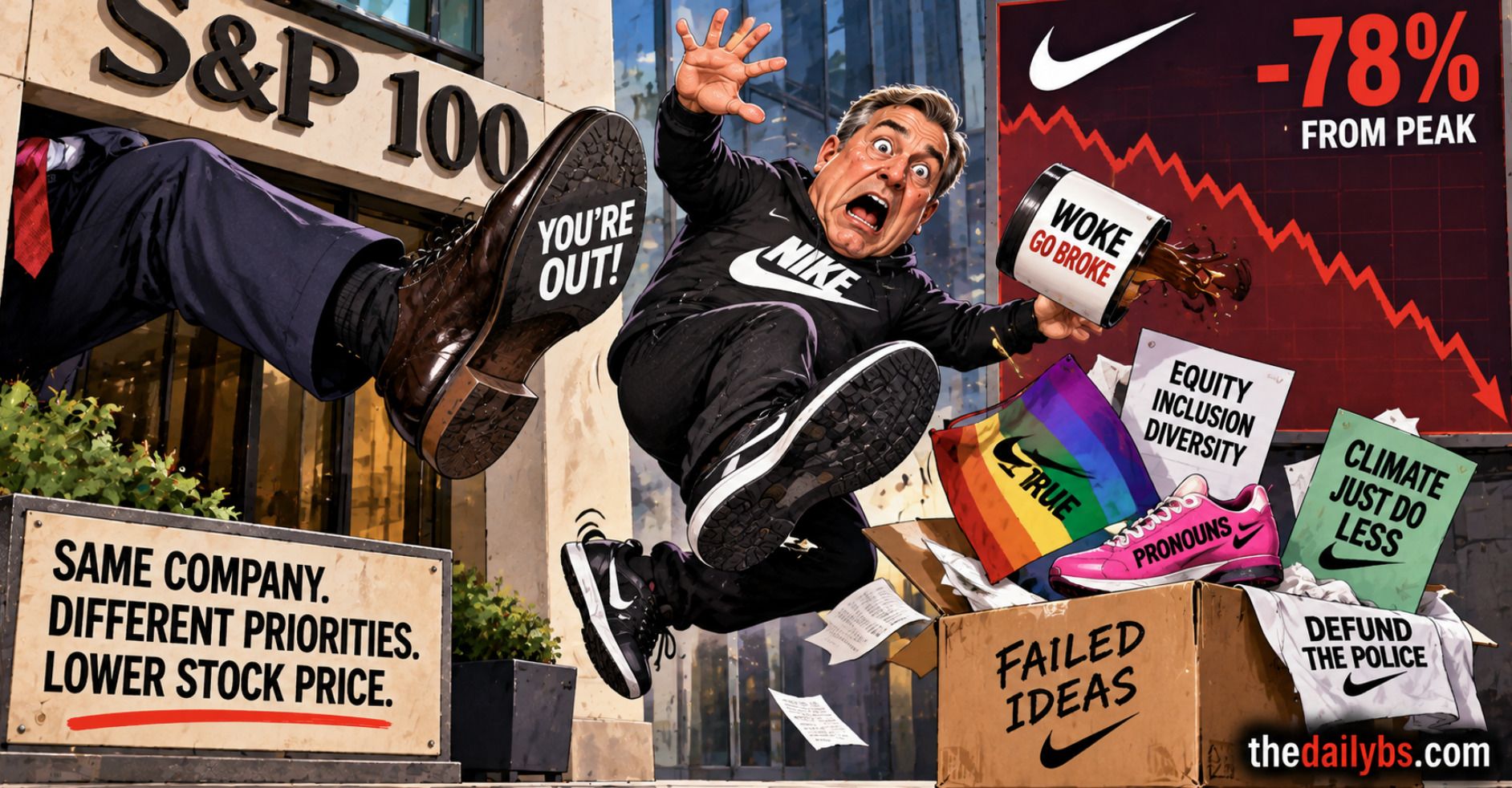
- Nike is being removed from the prestigious S&P 100 after its stock plunged roughly 78% from its 2021 peak.
- The athletic giant’s decline comes after years of business mistakes, rising competition and weakness in China — but also years of highly political marketing that alienated a significant segment of American consumers.
- Colin Kaepernick, the Betsy Ross sneaker controversy and Dylan Mulvaney all became flashpoints as Nike increasingly waded into America’s culture wars.
The Swoosh is getting the boot.
Nike will be removed from the S&P 100 later this month, a symbolic demotion for a company that once seemed practically untouchable as one of America’s premier consumer brands. S&P Dow Jones Indices announced that Nike will leave the blue-chip index before trading opens Sept. 21. Palo Alto Networks will take its place.
Nike isn’t being kicked out of the broader S&P 500. But its removal from the S&P 100 comes after a brutal stretch for shareholders. The company’s stock has fallen roughly 78% from its 2021 peak, according to Forbes, and at one point this summer reached levels not seen in more than a decade.
And while Nike’s business problems are real and well documented, there’s another chapter to this story that can’t simply be erased: Nike spent years deliberately inserting itself into America’s political and cultural battles.
Well, Nike sure owned the floor.
And busted right through it.
Get woke, go broke. https://t.co/g5X7ZTP0OB pic.twitter.com/p02TlCkZsc
— Spencer Pratt (@spencerpratt) September 6, 2026
It started paying dividends — at least initially. In 2018, Nike made former NFL quarterback Colin Kaepernick, whose national-anthem protests had made him one of America’s most polarizing athletes, the centerpiece of its 30th anniversary “Just Do It” campaign.
Conservatives threatened boycotts. Some customers publicly destroyed their Nike gear. And Nike initially won the bet.
Online sales jumped 31% during the Labor Day period immediately following the campaign’s launch, according to Edison Trends data reported at the time. Nike later touted record engagement with the brand.
Then came the Betsy Ross sneaker. In 2019, Nike scrapped a planned Fourth of July Air Max shoe featuring the 13-star American flag after Kaepernick reportedly raised concerns about the symbol.
The decision triggered another political firestorm. Then-Arizona Gov. Doug Ducey accused Nike of bowing to “political correctness and historical revisionism,” while Sen. Ted Cruz was among the conservatives who blasted the company.
Again, however, there was no immediate financial collapse. An analysis of online sales during the days following that controversy found no significant drop.
Nike kept going.
Following George Floyd’s death in 2020, the company turned its famous slogan upside down with its “For Once, Don’t Do It” racial-justice campaign.
Nike, Jordan Brand, Converse, and Michael Jordan also committed a combined $140 million over 10 years to organizations focused on racial inequality, economic empowerment, education and social justice.
And in 2023 came another cultural explosion. Transgender influencer Dylan Mulvaney appeared in a paid Nike partnership modeling the company’s women’s leggings and sports bra.
BREAKING: Nike is set to be removed from the S&P 100 after nearly 18 years.
The stock is now down almost 80% from its 2021 peak, turning one of the market’s most iconic consumer brands into one of its biggest recent disappointments. pic.twitter.com/3uJNIxcg4j
— I Meme Therefore I Am 🇺🇸 (@ImMeme0) September 5, 2026
The backlash was immediate.
Former Olympic swimmer Sharron Davies criticized the company for using Mulvaney to promote women’s athletic clothing while female athletes struggle for sponsorship dollars. Caitlyn Jenner called Nike “woke.” Conservative consumers again called for a boycott, and one viral protest featured a woman burning Nike sports bras.
None of that proves those controversies caused Nike’s stock collapse. There are plenty of decidedly nonpolitical reasons for Nike’s troubles. The company became overly dependent on aging sneaker franchises, stumbled badly with a direct-to-consumer strategy that damaged important wholesale relationships, and lost ground to increasingly formidable competitors including Hoka and On.
China has also become a major problem.
Nike’s footwear market share has slipped, its product innovation has been questioned, and newer competitors have chipped away at a competitive moat investors once regarded as nearly impregnable.
But dismissing the cultural backlash entirely would miss something important about what happened to the Nike brand. For years, conservative customers publicly warned the company that its political positioning was driving them away. Just last month, as Nike shares hit a 12-year low, Cruz revisited the issue.
“For my whole life, I wore nearly 100% Nike for athletic wear,” the Texas Republican wrote on X.
Sad & predictable.@nike lost me at #2.
For my whole life, I wore nearly 100% Nike for athletic wear.
Kaepernick pissed me off, but when they cancelled the Betsy Ross shoe it showed that their marketing plan was America-hate.
I went out & bought brand new shoes, shorts,… https://t.co/QpgqtCrScf
— Ted Cruz (@tedcruz) August 18, 2026
Kaepernick angered him, Cruz said, but the canceled Betsy Ross shoe finally drove him away from the brand.
“I went out & bought brand new shoes, shorts, t-shirts,” Cruz wrote. “Turns out I wasn’t the only one.”
He added the hashtag: “#GoWokeGoBroke.”
Whether Wall Street can put a dollar figure on that alienation is another matter.
Nike spent years changing what the Swoosh represented to millions of Americans. For some consumers, that strengthened the brand. For others, it turned an athletic company they had happily supported for decades into another participant in a political culture war they never asked their sneakers to join.
Meanwhile, competitors arrived offering consumers plenty of other places to spend their money.
Now comes the symbolism. Nike is leaving the S&P 100 along with Honeywell Aerospace, Simon Property Group and Colgate-Palmolive. Coming in are Dell Technologies, Palo Alto Networks, Arista Networks and Sandisk.
All four are technology companies. It’s a remarkable changing of the guard.
Nike once embodied almost everything Wall Street wanted from an American consumer powerhouse: cultural dominance, global scale, pricing power and a brand that appeared nearly impossible to dislodge. Today, the company is fighting to regain customers, rebuild wholesale relationships, revive innovation, stabilize China and prove the Swoosh still carries the power it once did.
Getting dumped from the S&P 100 didn’t cause Nike’s problems. It may simply be the clearest symbol yet of how far one of America’s most dominant brands has fallen.
MY QUICK TAKE
“Go woke, go broke” is a great bumper sticker. Corporate decline is usually more complicated.
Nike made business mistakes. Hoka and On started eating its lunch. China went south. The products got stale. But Nike also spent years practically daring a chunk of its own customers to shop somewhere else.
Some of them did.
Now the stock is down 78% from its peak, and Nike is being bounced from the S&P 100. Maybe insulting customers wasn’t responsible for every mile of the fall. But I’m not convinced it helped sell many sneakers on the way down.
DBS WIRE SOURCES:
- S&P Global — Nike to leave S&P 100 in September index reshuffle
- Forbes — Nike stock fell 78% and S&P 100 exit may mark capitulation
- Mediaite — Ted Cruz unloads on Nike after stock crashes to 12-year low
- Washington Post — Nike pulls Betsy Ross flag sneaker after Kaepernick complaint
- Marketing Dive — Nike sales jumped after Kaepernick campaign
- Time — Nike faces backlash over Dylan Mulvaney partnership
- Nike — Our Commitment to the Black Community